A curated journey · Designed and researched by Parth
Three Nights on the Monterey Peninsula
Carmel-by-the-Sea · Pebble Beach · Monterey · Pacific Grove — sixty square miles that hold a village, a golf course, a forest, and the best cold-water coastline in America.
Curator's Statement
You could see the Monterey Peninsula in a day. You should not.
This is the stretch of the California coast I know best, and the mistake almost everyone makes is treating it as a stop on the way to Big Sur rather than a destination in its own right. Three nights is enough to do it properly: a morning on two wheels along the water before the town wakes up, a slow afternoon in Carmel's galleries, a hike to the one point on the peninsula where you can see the whole thing at once, and an evening that ends with a bagpiper walking a golf course to sleep. None of it is rushed, and none of it needs to be — sixty square miles, driven end to end, takes forty minutes; lived in properly, it takes three days and you will still want a fourth.
Each day below opens with a short narrative of what to do and why, followed by insider notes — the things that are easy to get wrong and expensive to learn the hard way. After that you will find where to eat, a sundowner for every evening, and the approximate cost of every ticket and excursion mentioned. Prices are in US dollars and were accurate at the time of writing. Restaurant reservations, tasting appointments and park fees change seasonally, so treat every figure as a planning estimate and confirm at the point of booking.
The Route at a Glance
A village, a bay, a forest and a golf course — forty minutes end to end, three days to live in.
Where you sleep, and what each day is for
| When | Where | Focus |
|---|---|---|
| Day 1 | Carmel-by-the-Sea | Arrival, galleries, Carmel Beach |
| Day 2 | Monterey and Cannery Row | Bike path, the Aquarium, Jacks Peak |
| Day 3 | Pebble Beach | Point Lobos, 17-Mile Drive, the Spanish Bay bagpiper |
| Day 4 | Departure | A Big Sur taster, or a slow morning in Carmel Valley |
How you move
- Into the peninsula by air — Monterey Regional Airport (MRY) sits ten minutes from Carmel and Monterey, with seasonal nonstops from Los Angeles, San Francisco, Denver, Phoenix, Dallas, Las Vegas and Seattle.
- By car from the north — two and a half hours from San Francisco, an hour and a half from San Jose.
- By car from the south — a ninety-minute Big Sur drive from Cambria or Pismo Beach, if you are arriving up the coast road.
- Once you are here — a car is essential for every day except Day 1, when Carmel itself is walked.
Arrive, park the car, and leave it parked for the first afternoon: Carmel-by-the-Sea is six blocks square and everything in it is a walk. From Day 2 the car does short hops only — ten minutes to Cannery Row, fifteen up to Jacks Peak, twenty to the Point Lobos gate. Nothing on this itinerary is a drive of consequence, which is exactly why three nights here feel longer than three nights anywhere else on this coast.
Part of the Highway 1 route
These three nights are written to stand alone, but they also slot directly into Days 5 to 7 of the eleven-day Highway 1 journey down the California coast. If you are driving from San Francisco to San Diego, add a night in Carmel and use this page for the peninsula days — the coastal bike ride, the Aquarium and Jacks Peak are the day that route does not have room for. Day 4 below then becomes the morning you leave for Big Sur.
Best months: September and October, the clearest and warmest weeks of the year on this coast. June to August brings the fog, and the peninsula can go a week without seeing the sun in July.
What This Trip Costs
Roughly $2,400 for two, done comfortably.
The figures below reflect two travelers sharing a room at The Classic tier, for three nights, in September or October — the clearest weather of the year on this coast.
Estimated budget · Two travelers · 3 nights
| Accommodation — 3 nights at The Classic tier, including tax and fees | $1,300 |
| Food and drink — lunches, dinners, coffee, and a sundowner every evening | $750 |
| Attractions and tickets — Point Lobos, 17-Mile Drive, the Aquarium, and bike rental | $250 |
| Drinks at Spanish Bay — two rounds at the fire pits, the bagpiper evening | $90 |
| Total, excluding car rental and travel to the peninsula | ≈ $2,400 |
Where the money actually goes: accommodation is more than half of it, because the peninsula has no cheap nights and the good addresses in Carmel are small hotels rather than large ones. Everything else is modest by California standards — the two headline experiences of the trip, sunrise at Point Lobos and the bagpiper at Spanish Bay, cost ten dollars a car and the price of a cocktail.
Leaner
≈ $1,900
Stay at Hofsas House, skip the Aquarium's evening add-ons, and treat the Bench at Pebble Beach as your one splurge lunch rather than adding a second fine-dining dinner.
Elevated
$4,500+
A night or two at The Inn at Spanish Bay itself so the bagpiper plays for you from your own balcony, Aubergine's tasting menu, and a private guide for Point Lobos at opening.
Car rental and travel to the peninsula are not included in the figure above — neither the flights or drive that get you here, nor the car you will need from Day 2 onward. Costs are estimates in US dollars and are intended for planning. They are not a quotation; final pricing depends on travel dates, availability, and how you choose to travel.
Day 1 · Carmel-by-the-Sea
A Village With No Street Addresses
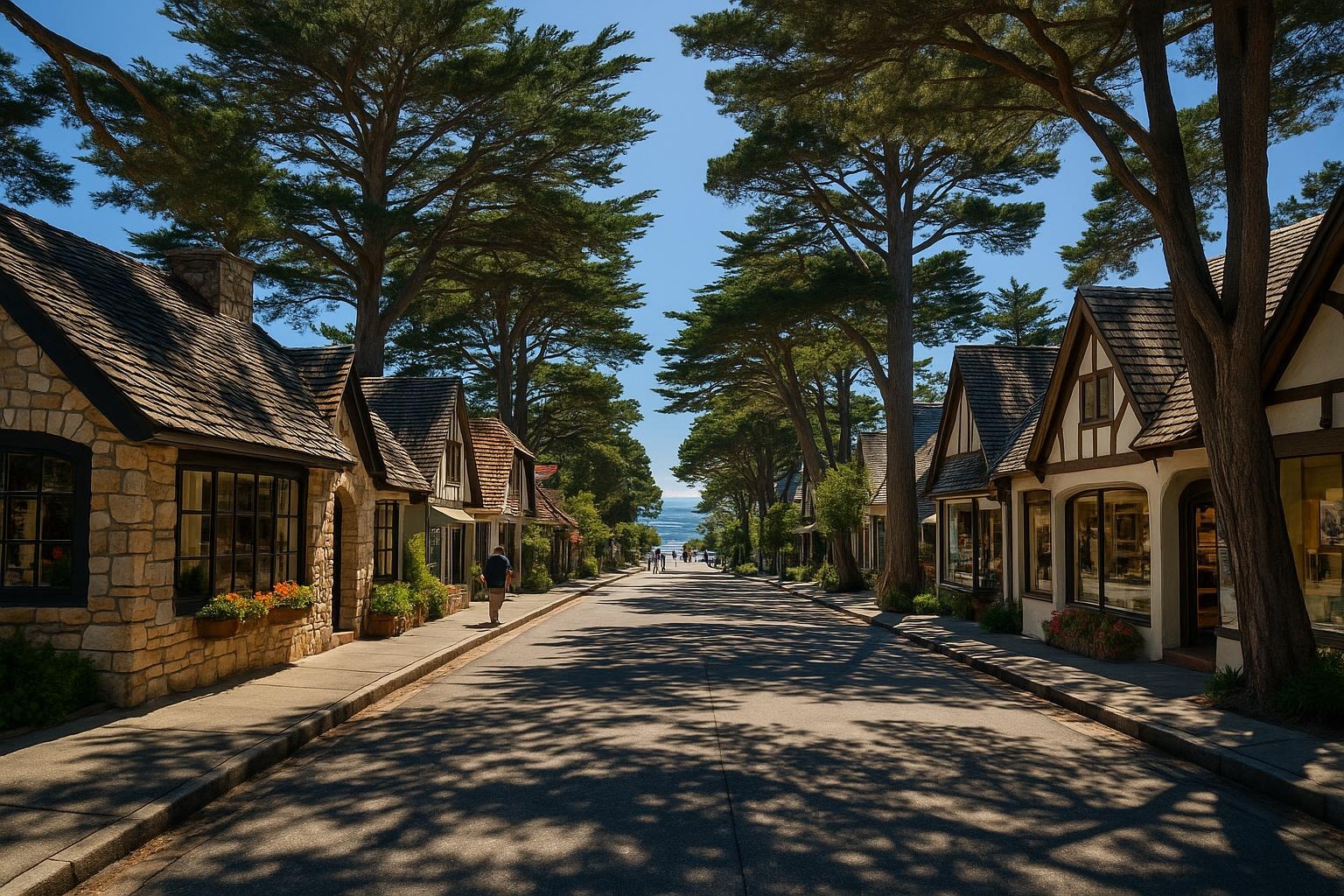
Ocean Avenue falling away to the sea — a village of storybook cottages with no addresses and no hurry.
Arrive, park the car, and do not touch it again today — Carmel-by-the-Sea is six blocks square and everything in it is a walk. Directions here are given by cross streets rather than addresses ("Dolores, between Fifth and Sixth"), houses have names instead of numbers, and the fairy-tale cottages lining the lanes were mostly built by writers and artists who came for the light a century ago and never left. Spend the first afternoon simply walking it: Ocean Avenue down to the beach, the side streets off Dolores and Lincoln, the hidden courtyards that only reveal themselves once you stop looking at a map.
Carmel's real business is its galleries, and there are close to a hundred of them packed into this square mile — more per capita than anywhere in the country outside New York. Start at the Carmel Art Association on Dolores, artist-run since 1927 and the oldest cooperative gallery on the peninsula; Weston Gallery on Sixth for photography, where the legacy of Edward Weston and Ansel Adams still shapes what hangs on the walls; Winfield Gallery for contemporary California work; Dawson Cole Fine Art for Richard MacDonald's bronze figures; and Gallery Sur, entirely devoted to Big Sur landscapes, for a preview of what tomorrow's drive will look like. Finish at the Carmel Mission, founded in 1771 and the burial place of Junípero Serra, before walking down to Carmel Beach for sunset — a wide crescent of white sand where the whole town turns out with dogs and wine to watch the sun go into the Pacific.
Where to Stay · The Monterey Peninsula, three nights
One base for all three nights. Carmel is the classic choice; Cannery Row is the alternative if you would rather wake up on the bike path.
The Classic
$300–400 a night- La Playa CarmelThe 1905 grande dame two blocks from the beach, with champagne and cheese at check-in and breakfast on the terrace.
- Cypress InnDoris Day's Spanish-Moorish inn, dog-friendly, with the liveliest lounge in the village.
- Hofsas HouseFor fourFamily-run, with ocean-view balconies and family suites that sleep four at the best price in town.
- Spindrift Inn, Cannery RowWildcardThe only hotel on the sand in Monterey, with wood-burning fireplaces — if you would rather sleep by the bike path and roll straight onto it tomorrow morning.
The Elevated
$600–1,300 a night- L'Auberge CarmelCouple's pickA twenty-room Relais & Châteaux with Aubergine, the Michelin-starred restaurant, downstairs.
- Bernardus Lodge & Spa, Carmel ValleyTen degrees warmer than the coast, with a serious spa and Lucia restaurant.
- Carmel Valley RanchFor fourFive hundred acres with golf, a lavender farm and two-bedroom suites for four friends.
- The Inn at Spanish Bay, Pebble BeachWildcardAt the top of the band — $900 to $1,300 — and the only way to hear the bagpiper from your own room.
Insider Notes
- Carmel's lack of street addresses is not a quirk to work around; build ten extra minutes into every walk. Your hotel will give you cross streets, not a number, and so will every restaurant reservation.
- If your dates land on the monthly Saturday-evening Art Walk, the galleries stay open late and pour wine — check the Carmel Art Association's calendar before you book flights, since it happens only once a month.
- Carmel Beach allows dogs off-leash and wine on the sand at sunset, which is the single best way to understand the town's character in one evening.
- Metered parking runs out at 6pm and Sundays are free — but the free residential streets a few blocks up from Ocean Avenue are the better bet any time, if you did bring the car into town for the first night.
- The Carmel Mission closes its interior by 5pm most days; time it before the gallery walk rather than after.
Where to Eat
- Dinner — La Bicyclette on Dolores: French-Italian, wood-fired, thirty seats, no pretension — the quintessential first-night-in-Carmel dinner. Book ahead.
- Alternative — Cultura Comida y Bebida, hidden in a courtyard just off Ocean Avenue, for Oaxacan cooking and the best mezcal list on the peninsula.
- Sundowner — a bottle from one of Carmel's own tasting rooms — Scheid or Caraccioli, both a short walk from the beach — drunk on the sand at Carmel Beach as the sun goes down. This is the ritual; the whole village does it every night.
Tickets & Costs
| Carmel Art Association and the galleries | Free |
| Carmel Mission Basilica, per person | $13 |
| Metered street parking, per hour | $3 |
Day 2 · Monterey & Cannery Row
The Bay, on Two Wheels, Before the Wind Comes Up
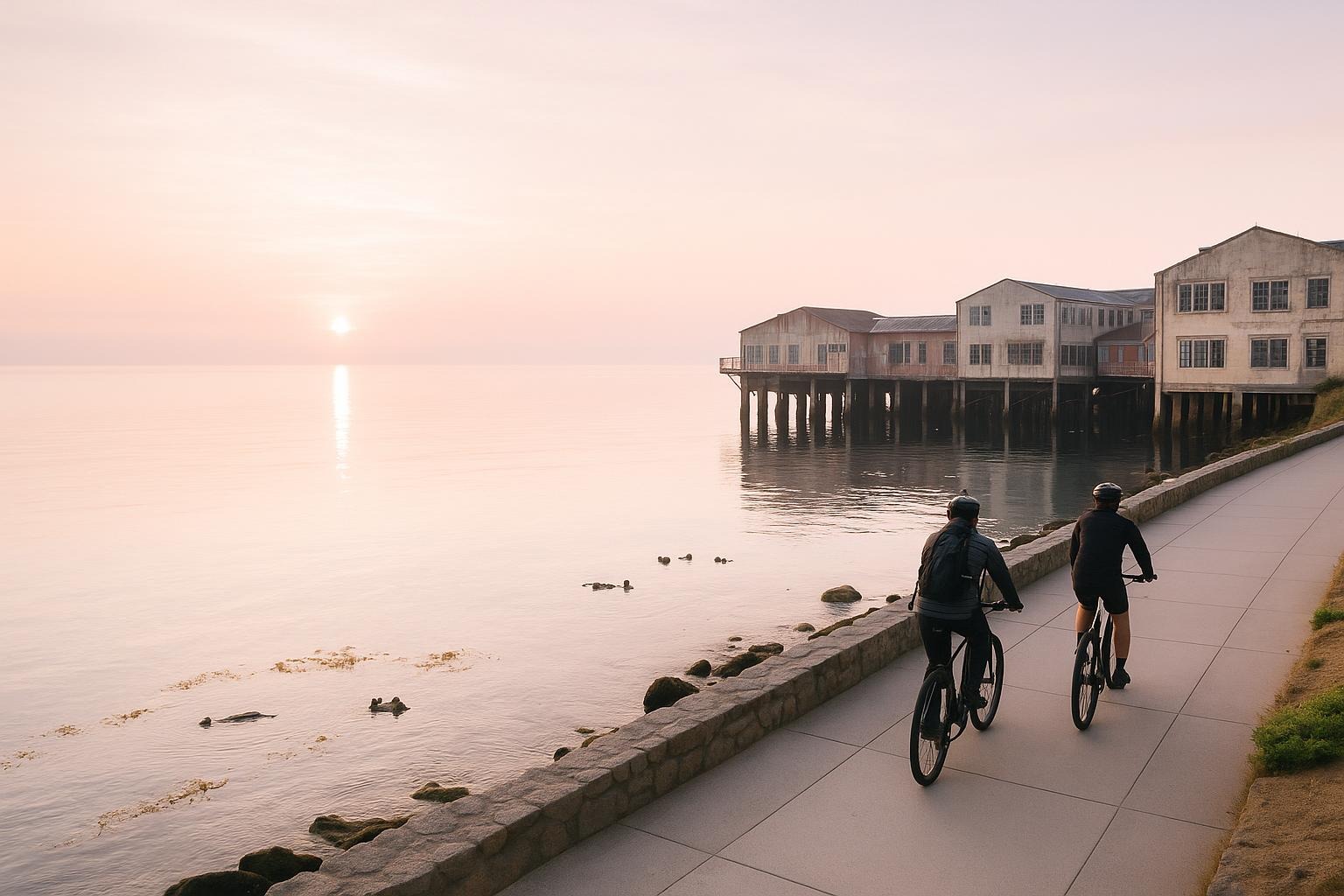
The bay like glass before nine, otters in the kelp, and fourteen flat miles of it to yourself.
Be on the Monterey Bay Coastal Recreation Trail by eight — ask your hotel for bikes the night before, or reserve at Adventures by the Sea on Cannery Row. This is one of the best scenic bike rides you will ever do: a flat, paved path that runs along Fisherman's Wharf, past the old canneries, alongside harbor seals hauled out at Hopkins Marine Station, around Lovers Point, and out along Ocean View Boulevard to Point Pinos Lighthouse and Asilomar. Fourteen miles round trip if you ride the whole thing, with sea otters floating on their backs in the kelp for nearly every mile of it, and the water at its calmest before the afternoon wind rises off the bay.
Return the bikes and be at the Monterey Bay Aquarium when it opens at ten — book timed tickets in advance. The kelp forest tank, the Open Sea gallery, and the otters at feeding time are worth the whole morning; two to three hours is about right. Snack at Wetzel's Pretzels on Cannery Row on the way out — always baked fresh — and then walk the old cannery district itself: the sardine-packing plants and workers' shacks that gave Steinbeck his novel are still standing along Cannery Row and Wave Street, and the Cannery Row Antique Mall, housed in the 1927 Carmel Canning Company warehouse, is two floors and more than a hundred dealers — the best browse on the peninsula for anyone who likes old glass, nautical brass, and California ephemera.
Late in the afternoon, drive fifteen minutes up to Jacks Peak, the highest point on the entire peninsula. The Skyline Nature Trail is an easy loop of under a mile through one of the last native Monterey pine forests on earth, and it is built like a slow reveal: it opens with Monterey Bay and the town laid out directly below you, swings around past views toward Pebble Beach and Pacific Grove, and finishes looking south over Carmel Valley and Carmel Bay to the Santa Lucia Mountains — the whole peninsula, one hike, start to finish.
Insider Notes
- Rent the bikes the night before if you can; Adventures by the Sea and Bay Bikes both open at eight and the earliest riders get the calmest water and the emptiest path.
- The Aquarium's timed-entry tickets sell out on weekends in summer and fall. Book online at least a few days ahead, and the first slot of the day is genuinely the best — otters are most active in the morning.
- Wetzel's Pretzels is a quick counter stop, not a sit-down meal — the point is a fresh-baked snack between the Aquarium and the cannery walk, not lunch itself.
- The Cannery Row Antique Mall is cash-and-card friendly but shipping is not offered by most dealers — factor a small item into carry-on rather than counting on it being sent home.
- Jacks Peak's entrance road is right by the Monterey Peninsula Airport, which makes it an easy stop on the way to or from a flight, not just a dedicated excursion.
- Layer up for the bike ride. Coastal fog can sit until ten even in September, and Ocean View Boulevard has no shelter from the wind on the way back.
Where to Eat
- Lunch — a grazing lunch on Cannery Row itself: Schooners Coastal Kitchen and Bar for a table on the water, or a quick fish taco stop, before or after the Aquarium.
- Dinner — Passionfish in Pacific Grove, a long-running seafood kitchen known for its sustainable sourcing and an exceptional, fairly priced wine list. Or Montrio Bistro in Monterey for a more polished, wood-fired menu in a converted firehouse.
- Alternative — a casual night at Cannery Row Brewing Company for the group that wants beer and a pretzel with beer cheese after the bike ride.
- Sundowner — the Jacks Peak overlook itself, if your timing allows: bring a thermos and watch the light change over the whole peninsula before driving back down.
Tickets & Costs
| Bike rental, half day, per person | $30–40 |
| Monterey Bay Aquarium, per adult | $65 |
| Wetzel's Pretzels, per pretzel | $6–8 |
| Cannery Row Antique Mall | Free entry |
| Jacks Peak County Park, per vehicle | $6 |
Day 3 · Pebble Beach
Point Lobos, Every Vista Point, and the Bagpiper
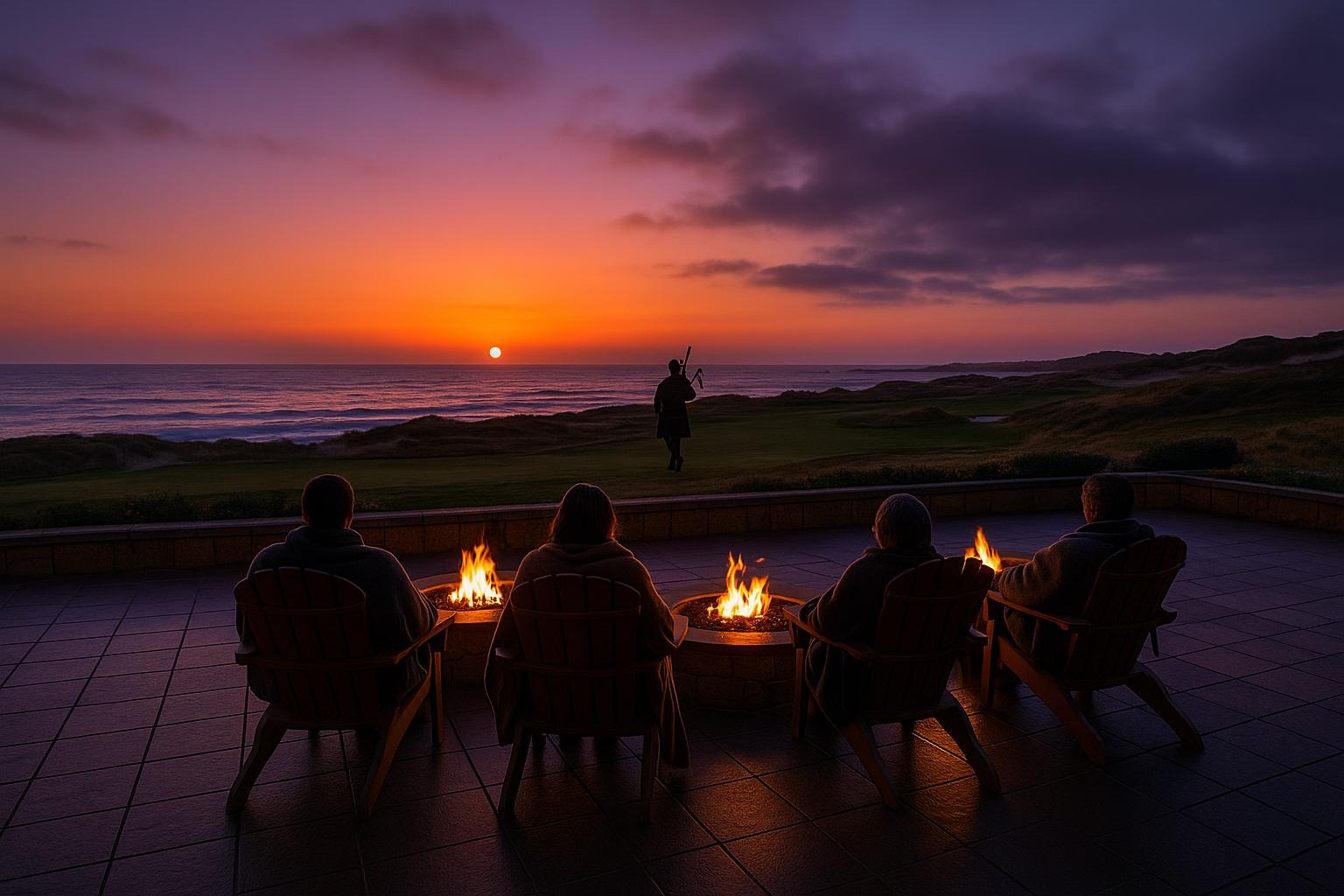
Fire pits, blankets, and a lone piper walking the links to sleep as the sun goes into the Pacific.
Be at Point Lobos when the gate opens at eight. This is the finest coastal walk in California — a state natural reserve of cypress-covered headlands, jade-green coves, sea lions barking on the rocks below, and, in season, gray whales passing so close offshore you can hear them breathe. The Cypress Grove and Sea Lion Point trails together take about two hours, and by ten the small parking lot is full and cars line the highway shoulder outside — arrive early or arrive on the shoulder.
Then enter 17-Mile Drive at the Carmel gate and drive it north, and the instruction for the day is simple: stop at every marked vista point on the map they hand you at the entrance. Pescadero Point and its wind-bent ghost trees, the Lodge at Pebble Beach for lunch over the 18th green, the Lone Cypress on its granite outcrop, Crocker Grove, Cypress Point, Fanshell Overlook, Seal Rock, Bird Rock, China Rock, Point Joe, the Restless Sea — the light changes at every turn, none of them takes more than ten minutes, and none of them is skippable. Finish the loop at The Inn at Spanish Bay in the late afternoon.
Take a drink to the outdoor fire pits by the Lobby Lounge terrace forty-five minutes before sunset, with a blanket from the staff. Every evening, rain or shine, a bagpiper begins on the first tee of the Links in front of Sticks and walks the fairways up to the fire pits over about forty-five minutes, finishing on the terrace as the sun goes into the Pacific. During daylight saving time the piper starts around 5:45pm; in winter, half an hour before sunset. The tradition began in 1987, after Tom Watson remarked that the course felt so Scottish you could almost hear the bagpipes. There is nothing else quite like it on this coast, and you do not need to be a hotel guest to be there — order a drink at the terrace and you are welcome.
Insider Notes
- Point Lobos's lot holds about 150 cars and fills by 9:30 on weekends. Eight o'clock, no exceptions, if you want to park inside the gate.
- 17-Mile Drive charges a small per-vehicle entry fee, refunded against a restaurant tab of $35 or more at any Pebble Beach property — lunch at The Bench covers it. Motorcycles are not permitted on the drive at all.
- Fanshell Overlook and Cypress Point Lookout close from April through May for harbor seal pupping season; the rest of the loop stays open year-round.
- Sit outside at the fire pits, not in the Lobby Lounge itself. Staff bring blankets for the wind off the dunes, and there is no cover charge to be there for the bagpiper — a drink is all that's expected.
- The bagpiper plays daily regardless of weather, so a foggy or drizzly evening is not a reason to skip it — if anything, the fog makes the sound carry further across the dunes.
Where to Eat
- Lunch — The Bench at The Lodge at Pebble Beach, on the terrace over the 18th green and Stillwater Cove: wood-fired flatbreads and arguably the best-located lunch table in California. The bill covers the 17-Mile Drive entry fee.
- Dinner — Chez Noir, a Michelin-starred neighborhood bistro in a Carmel cottage and the hardest reservation on the peninsula — book the day the calendar opens. Or Roy's at Pebble Beach, inside The Inn at Spanish Bay itself, so dinner flows straight out of the bagpiper evening.
- Alternative — Aubergine at L'Auberge Carmel for the tasting-menu splurge.
- Sundowner — the fire pits at The Inn at Spanish Bay, a glass of Monterey County pinot noir, and the piper coming up the fairway. This is the evening the whole itinerary is built around.
Tickets & Costs
| Point Lobos State Natural Reserve, per vehicle | $10 |
| 17-Mile Drive, per vehicle (refundable against a $35 tab) | $12.25 |
| Drinks at the Spanish Bay fire pits, per cocktail | $18–25 |
| Roy's at Pebble Beach or the Lobby Lounge, dinner for two | $150–220 |
Day 4 · Departure
One Last Look South, or a Slower Morning
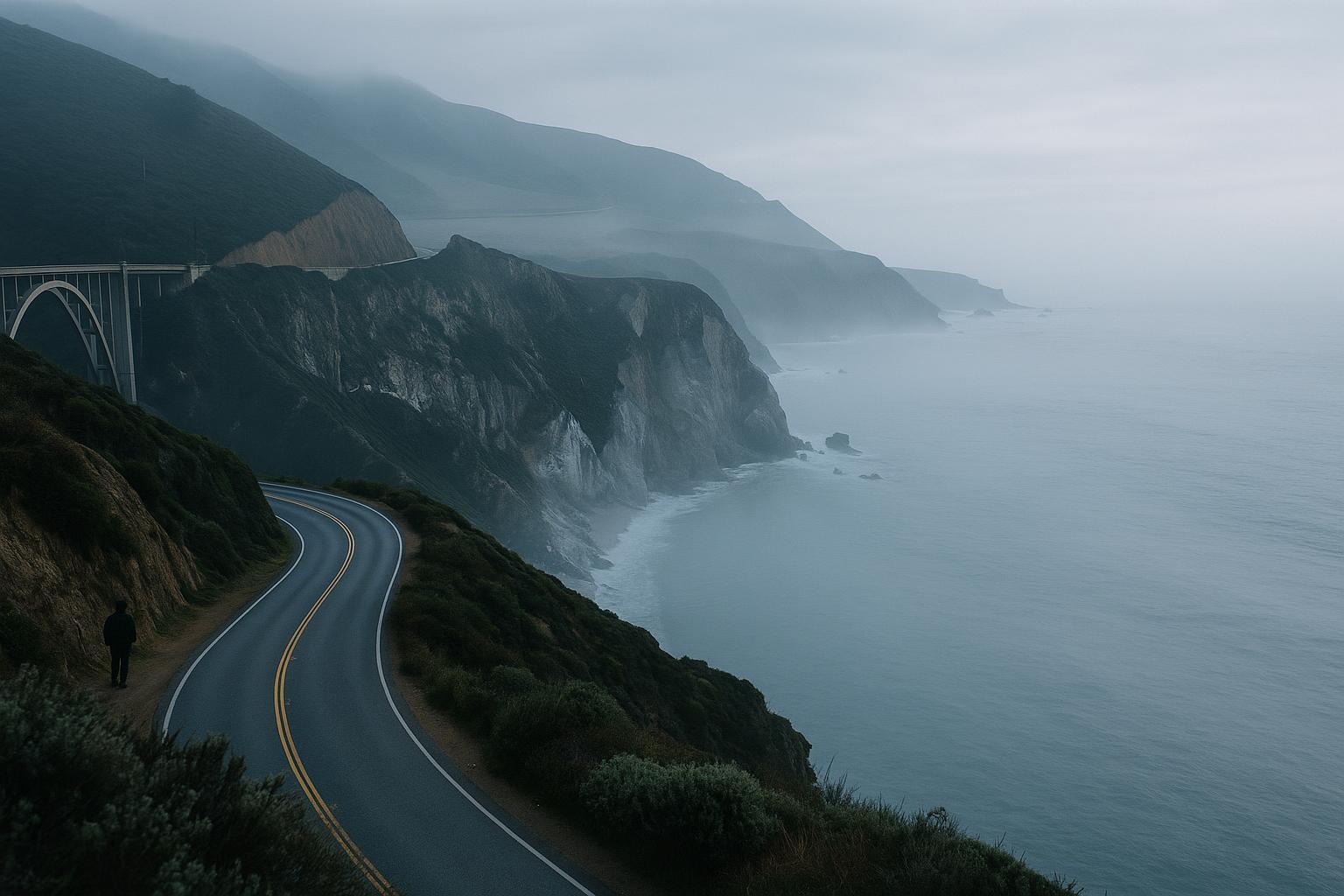
One last look south — Big Sur begins twenty minutes from your door.
The fourth morning is a choice rather than a fixed plan, and either version fits comfortably before an afternoon flight out of Monterey or a drive south. The first option is a Big Sur taster: leave by eight for the twenty-minute drive to Bixby Creek Bridge, park at the north turnout while the light is still low, and continue on to Nepenthe for an early lunch on the terrace eight hundred feet above the water — ninety minutes round trip from Carmel if you turn around after lunch, or the start of the full Highway 1 drive south if that is where the road is taking you next. The second option is a slower morning in Carmel Valley Village, ten minutes inland and noticeably warmer than the coast, with a last tasting at Folktale Winery before the drive to the airport.
Insider Notes
- Fuel up before Big Sur; there is one gas station along the ninety-mile stretch and it prices accordingly.
- Nepenthe does not take terrace reservations. Arrive before eleven or you may wait; the view is worth it either way.
- Monterey Regional Airport (MRY) is a small, easy terminal — plan to arrive ninety minutes before a domestic flight, not the two hours a larger airport would demand.
Where to Eat
- Early lunch — Nepenthe, on the terrace eight hundred feet above the water, if you take the Big Sur morning. Before eleven, or expect to wait.
- Or a last tasting — Folktale Winery in Carmel Valley Village, ten minutes inland and noticeably warmer than the coast, if you take the slower morning instead.
Tickets & Costs
| Bixby Creek Bridge overlook | Free |
| Folktale Winery tasting, per person | $30–45 |
Keep driving south?
If the Big Sur taster only makes you want the rest of it, Day 4 becomes the first hour of the full coast drive — Bixby Bridge, Pfeiffer Beach, Nepenthe, McWay Falls, the elephant seals at Piedras Blancas and Hearst Castle — written in full as Day 7 of the eleven-day Highway 1 journey, with a Plan B for the days the road is closed.
Before You Go
Book these before you leave home.
Three things on this itinerary sell out days to weeks ahead in season, and there is no walk-up alternative for any of them.
What sells out
- The Monterey Bay Aquarium's timed entry — on weekends in particular, days to weeks ahead in season, for Day 2
- Chez Noir in Carmel — the day the reservation calendar opens, for Day 3
- A room at The Inn at Spanish Bay itself — if you want the bagpiper from your balcony rather than the terrace
- Plus the tables that reward a little foresight: La Bicyclette and Aubergine in Carmel, and Passionfish in Pacific Grove. If your dates might land on the monthly Saturday-evening Art Walk, check the Carmel Art Association's calendar before you book flights.
Every ticket, gathered · per person unless noted
| Carmel-by-the-Sea · Day 1 | |
| Carmel Art Association and the galleries | Free |
| Carmel Mission Basilica | $13 |
| Metered street parking, per hour | $3 |
| Monterey and Cannery Row · Day 2 | |
| Bike rental, half day | $30–40 |
| Monterey Bay Aquarium, per adult | $65 |
| Wetzel's Pretzels, per pretzel | $6–8 |
| Cannery Row Antique Mall | Free entry |
| Jacks Peak County Park (per vehicle) | $6 |
| Pebble Beach · Day 3 | |
| Point Lobos State Natural Reserve (per vehicle) | $10 |
| 17-Mile Drive (per vehicle, refundable against a $35 tab) | $12.25 |
| Drinks at the Spanish Bay fire pits, per cocktail | $18–25 |
| Roy's at Pebble Beach or the Lobby Lounge, dinner for two | $150–220 |
| Departure · Day 4 | |
| Bixby Creek Bridge overlook | Free |
| Folktale Winery tasting | $30–45 |
Getting here
- By air. Monterey Regional Airport (MRY) sits ten minutes from Carmel and Monterey, with seasonal nonstops from Los Angeles, San Francisco, Denver, Phoenix, Dallas, Las Vegas and Seattle. It is a small, easy terminal — ninety minutes before a domestic flight is enough, not the two hours a larger airport would demand.
- By car. Two and a half hours from San Francisco, an hour and a half from San Jose, and a ninety-minute Big Sur drive from Cambria or Pismo Beach if you are arriving from the south.
- Once you are here. A car is essential for every day except Day 1, when Carmel itself is walked. If you fly in and would rather not drive at all, the peninsula's short hops are cheap by rideshare — but the 17-Mile Drive on Day 3 charges per vehicle and is not a rideshare route, so a car for at least that day is the sensible answer.
Money and tipping
- Tipping is not optional. Eighteen to twenty percent of the pre-tax bill in restaurants, twenty for good service; a dollar or two per drink at the bar; $5 to $10 a day for housekeeping; $5 for a valet. Tasting-room staff appreciate a tip on a good pour but do not expect one.
- Sales tax is added at the register, not shown on the shelf — between 7.25 and 10.75 percent depending on the county. Menu prices are pre-tax and pre-tip; a $100 dinner is $130 out the door.
- Hotel taxes and fees are the real sting. Monterey County adds a lodging tax plus a tourism assessment, and many of the resort properties — Pebble Beach and Carmel Valley in particular — add a "resort fee" or "destination fee" of $30 to $60 a night on top. Every rate in this itinerary is quoted before these; budget for them.
- Cards are accepted everywhere on the peninsula, including at the farmers markets and the food trucks. Decline dynamic currency conversion if a card terminal offers to charge you in your home currency; the rate is always worse.
Driving on the peninsula
- Fuel up before Big Sur. There is one gas station along the ninety-mile stretch and it prices accordingly; California fuel is the most expensive in the mainland US, and most expensive of all down that road. Fill up in Carmel.
- Point Lobos parking is the whole game. The lot holds about 150 cars and fills by 9:30 on weekends; when it is full you park on the highway shoulder and walk in. Eight o'clock, no exceptions.
- Car break-ins are the practical crime risk at coastal trailheads. Never leave anything visible in a parked car — not a jacket, not a charging cable.
- Fog changes the road. The marine layer can drop visibility to a few car lengths on Highway 1 in the morning and evening. Headlights on, and slow down.
September and October — the seasonal reality
- These are the finest weeks of the year on this coast — the fog retreats, the water is at its warmest, the hills are gold — and they are also fire season. Most years nothing happens; some years the air fills with smoke and a park or a road closes for a week. Travel insurance that covers cancellation for wildfire is worth the premium.
- Summer, by contrast, is fog: "June gloom" sits over the coast most mornings and often all day, and the Monterey Peninsula can go a week without seeing the sun in July. Spring, from mid-April to May, is the second-best window: green hills, wildflowers, whales, and prices well below September.
- Restaurants here open at five for dinner and are often closed on Mondays and Tuesdays in the smaller towns — Carmel and Carmel Valley especially. Sunday brunch is a competitive sport everywhere. Book.
Practical odds and ends
- Layers decide how much you enjoy this trip. A Pacific Grove morning on the bike path is 52°F with the fog in; a Carmel Valley afternoon the same day is 85. Pack for both, every day, and keep a jacket in the car.
- The sun is stronger than it feels. The marine layer diffuses it and people burn through fog. Sunscreen and a hat on the bike day and at Point Lobos.
- Tap water is excellent everywhere on the peninsula. Carry a bottle; the parks and trailheads have refill stations, and a bottle of water at a beach concession is $4.
- Sea lions, seals and otters are protected by federal law. Stay fifty feet back on land and in the water — the fines are real, and the sea lions bite. You will be closer to otters here than anywhere else in California; keep the distance anyway.
- Poison oak lines the trails. Three leaves, waxy, red in autumn. Long trousers on the Point Lobos and Jacks Peak trails if you are prone to it.
- Reservations run on apps. Resy, OpenTable and Tock hold most of the tables in this itinerary; set alerts for the hard ones. Walk-in culture survives only at the taco counters and the oyster bars.