A curated journey · Designed and researched by Parth
Eleven Days on Highway 1
San Francisco · Sonoma · Carmel & Big Sur · The Santa Ynez Valley · Santa Monica · San Diego — one road, six Californias: fog, vines, cliffs, canyons, sand, and sun.
Curator's Statement
The mistake people make with California is trying to see it. This is a coast you drive, and the driving is the point.
I designed this route the way I would drive it myself: landing in San Francisco and leaving the car for three days, because the city is best on foot and by bike and the parking is a crime. One night in Sonoma, because a road trip should begin with a glass of wine and not with a freeway. Two nights in Carmel, so that the Monterey Peninsula — the stretch of this coast I know best — gets a full day rather than a drive-through, and so that Big Sur is met early in the morning with the road to yourselves. Then the long, slow descent: a night in wine country above Santa Barbara, a night on the sand in Santa Monica, and two nights in San Diego, where the trip ends in seventy-degree weather ten minutes from the airport.
Most Highway 1 itineraries are written as a list of viewpoints. This one is written around evenings — the bagpiper at Spanish Bay, sunset from Carmel Beach, a fire pit above the Pacific in Pismo, the skyline from Coronado — because those are the moments people remember, and they only happen if the day is paced to arrive on time.
It is built for two kinds of travelers. A couple in their early thirties who want wine country, cliffside sunsets and one or two dinners they will talk about for years. Or four friends in their thirties and forties who want exactly the same, plus a rooftop, a brewery, and a convertible with the top down. Every stop has two tiers of hotel — The Classic at roughly $300 to $400 a night, and The Elevated at $600 to $1,000 — and the days work identically with either.
Eleven days, one road, and not a single freeway you did not choose.
Each day below opens with the drive — miles, hours, and the road — then a short narrative of what to do and why, followed by insider notes: the things that are easy to get wrong and expensive to learn the hard way. After that, where to sleep at both tiers, where to eat including a sundowner for every day, because on this coast the sunset is the main event, and the price of every ticket, park fee and excursion mentioned. Prices are in US dollars and are planning estimates, not quotations; confirm at the point of booking. Restaurants should be reserved ahead — the good rooms on this coast are small, and they fill weeks out in September.
The Route at a Glance
North to south, fog to sun, with the ocean always on the right.
Where you sleep
| When | Where | Nights |
|---|---|---|
| Days 1–3 | San Francisco | 3 |
| Day 4 | Sonoma Valley | 1 |
| Days 5–6 | Carmel-by-the-Sea | 2 |
| Day 7 | Santa Ynez Valley (or Pismo Beach) | 1 |
| Day 8 | Santa Monica & Venice Beach | 1 |
| Days 9–10 | San Diego | 2 |
| Day 11 | Departure from San Diego | — |
| Optional | Four more nights in Los Angeles after Day 8 | +4 |
How you move
- Into San Francisco — fly into SFO. A rideshare or taxi covers the 35 to 45 minutes downtown; you will not need a car for three days and should not pay to park one.
- San Francisco to San Diego — a one-way rental car, collected downtown on the morning of Day 4 and dropped at San Diego airport on Day 11. Seven days of driving covers wine country, the coast road, Big Sur, and the Southern California beaches, which no train reaches.
- Around San Francisco — on foot, by bike, and by rideshare. The cable cars are transport as well as theater.
- Home from San Diego — fly out of SAN, ten minutes from downtown. Book the flights as an open-jaw ticket — into SFO, out of SAN — which usually costs no more than a round trip.
This structure exists for a reason. San Francisco is the one city on this route where a car is a liability: parking runs $60 to $80 a night, the hills eat gearboxes, and the neighborhoods are closer on foot than they look on a map. Collecting the car on the way out of town saves three nights of parking and a great deal of temper. At the other end, San Diego's airport sits so close to downtown that the last morning is a ten-minute drive rather than a dawn transfer.
The one thing to know
Highway 1 through Big Sur is the most beautiful road in the world and also the most frequently closed — by landslides in winter and wildfires in late summer. It fully reopened in January 2026 after nearly three years of slide closures. Check Caltrans QuickMap the night before you leave Carmel; Day 7 has a built-in Plan B either way, and the day still works.
Best months: September and October (the warmest, clearest weeks on the coast) and mid-April to May (green hills, wildflowers, whales, fewer crowds). June to August brings the fog; December to February is storm season.
What This Trip Costs
Roughly $10,400 for two, done comfortably.
The figures below reflect a comfortable, well-appointed version of this itinerary for two travelers sharing a room at The Classic tier, in September or October — the finest weather of the year on this coast, and priced accordingly. International airfare is not included.
Estimated budget · Two travelers · 10 nights
| Accommodation — 10 nights across six properties at The Classic tier, including tax and fees | $4,300 |
| Food and drink — lunches, dinners, coffee, wine, and a sundowner every evening | $2,600 |
| Car rental — 7 days, mid-size automatic, one-way drop fee, fuel, tolls and hotel parking | $1,300 |
| Attractions and tickets — every admission, park fee, tasting and excursion listed, for two | $1,100 |
| Tips, incidentals, souvenirs — California tips at 18 to 20 percent, and a case of Sonoma wine | $600 |
| Bikes and boats — San Francisco, Santa Monica and the La Jolla kayaks | $400 |
| Airport transfer — SFO to downtown on arrival | $70 |
| Total, excluding international flights | ≈ $10,400 |
Where the money actually goes: accommodation is just over forty percent of the budget, and unlike Italy it is spread evenly rather than concentrated in one splurge — this coast simply has no cheap nights. Food is the second line, and it is where California rewards you: the produce, the fish and the wine are the best in the country, and a $60 lunch on the Pebble Beach terrace or a $200 dinner in Carmel is money well spent in a way that a $200 dinner in a hotel lobby is not.
Leaner
≈ $7,500
Well-located inns and motels (Hofsas House in Carmel, the Inn at Sonoma, the Sideways Inn in Buellton), lunch as the main meal three days out of ten, and skip the Hearst Castle tour and the kayak. Nothing on the driving route changes.
Elevated
$18,000+
The Elevated tier throughout — Four Seasons, Farmhouse Inn, L'Auberge Carmel, Mattei's Tavern, Shutters, the Del — a convertible rather than a mid-size, private guides for Alcatraz and the Aquarium, and dinner at Aubergine and Providence rather than the bistros.
Four friends, two rooms
≈ $17,000
For the group at The Classic tier, because the car, the fuel and most of the tastings are shared. Ask about connecting rooms and two-bedroom suites at Carmel Valley Ranch, Alisal Ranch and the Marina del Rey Hotel.
Off-season
25–35% less
The same itinerary from November to March costs materially less and brings whale season, the monarch butterflies at Pismo and Pacific Grove, and green hills in Sonoma. The trade is shorter days, winter storms, and a higher chance that Big Sur is closed by a slide.
The Los Angeles extension — four more nights after Day 8 — adds roughly $2,600 at The Classic tier and $5,500 at The Elevated. Costs are estimates in US dollars and are intended for planning. They are not a quotation; final pricing depends on travel dates, availability, and how you choose to travel.
Day 1 · San Francisco
Landing at the Edge of the Continent
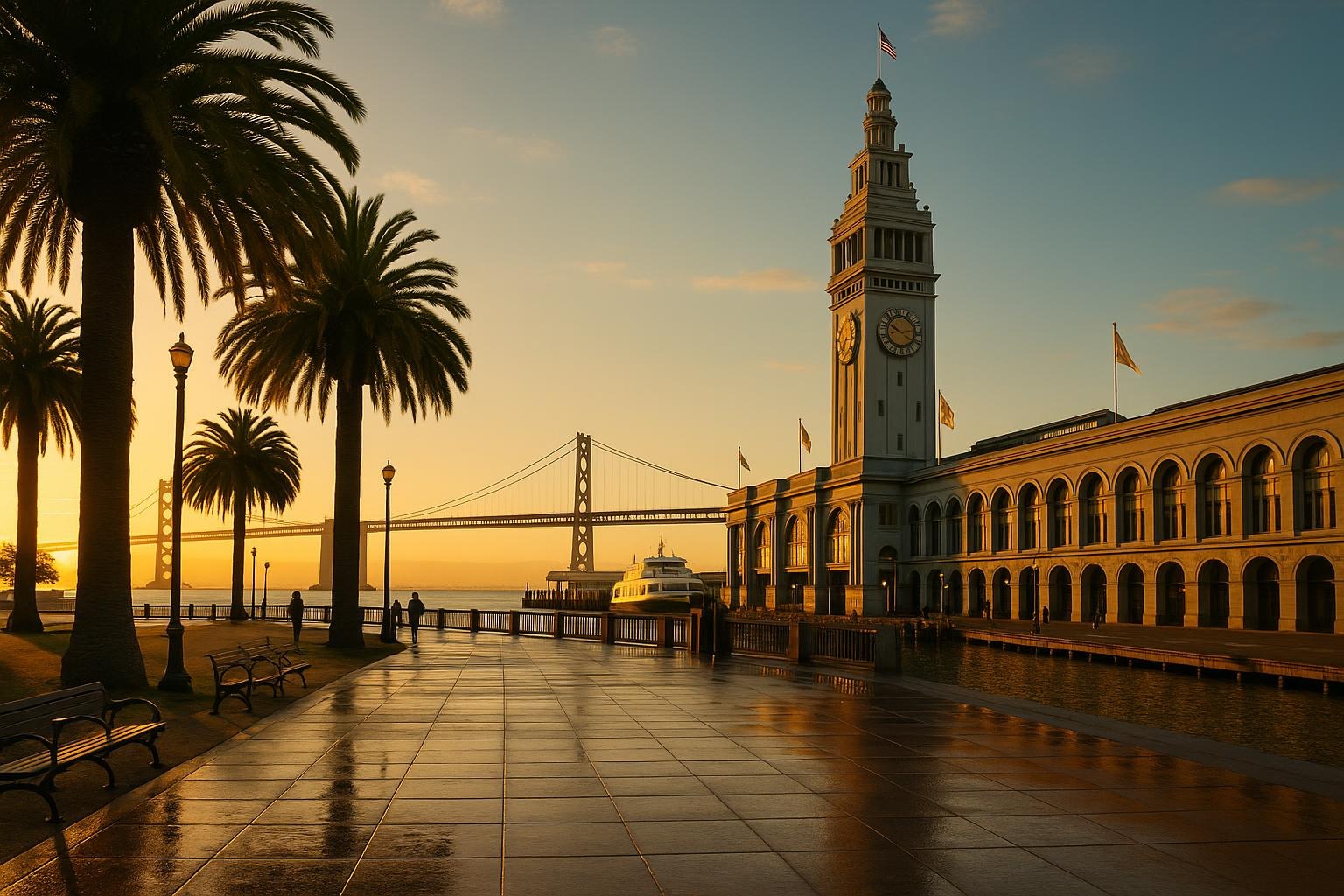
The Ferry Building as the light goes gold — the city's front door, and the oysters are just inside.
Land at SFO and go straight downtown by rideshare; the drive up the 101 takes forty minutes and delivers you to the door of your hotel with the afternoon still intact. Check in, leave the bags, and walk — not ride — to the Embarcadero. The Ferry Building is the right first hour in this city: an 1898 railway-era hall turned food market, with the Bay Bridge framed at the end of every doorway. Oysters at Hog Island, a first Blue Bottle, a slab of Acme bread, and the sense, standing on the water with the ferries coming and going, that you have arrived somewhere that faces the sea rather than the road.
Walk north along the piers as the light goes, past the old finger piers and the Exploratorium to Pier 39 if you want the sea lions, and then turn inland into North Beach for dinner. This is the Italian quarter Ferlinghetti and Kerouac drank in, and it is still the best first-night neighborhood in the city: small, walkable, loud in the right way. Dinner at Sotto Mare for cioppino, a nightcap at Vesuvio across the alley from City Lights, and an early night — the next two days are long.
Where to Stay · San Francisco, three nights
Every hotel here sits well clear of the Tenderloin, Civic Center and Mid-Market.
The Classic
$300–400 a night- Stanford Court, Nob HillAt the very top of the hill beside Grace Cathedral and Huntington Park, with the California Street cable car at the door. The calm, classic address, and usually under the band.
- The Clancy, Autograph Collection, SoMaFor fourOn the Embarcadero side of SoMa by Salesforce Park and Oracle Park; roomy double-queen rooms make it the pick for four friends.
- Hotel Kabuki, JapantownCalm, design-led, with Japanese soaking tubs; a short ride from everything.
- Hotel Drisco, Pacific HeightsWildcardA mansion-district hideaway on the city's quietest streets, with an evening wine hour and a morning house car downtown. Runs $400 to $500 and worth it for anyone who wants zero city grit.
The Elevated
$600–1,000 a night- Four Seasons Hotel San Francisco at EmbarcaderoTower rooms over the Bay Bridge — the best-located luxury address in the city.
- The Ritz-Carlton, San FranciscoNob Hill grandeur at the Chinatown border, walking distance to North Beach.
- Cavallo Point Lodge, SausalitoWildcardSleep beneath the Golden Gate in converted army officers' quarters. Consider it for the third night, so that you wake up on the Marin side before Sonoma.
Insider Notes
- Do not rent a car at the airport. Overnight parking downtown runs $60 to $80, the hills are hard on nerves and gearboxes, and everything on the next three days is reachable on foot, by bike or by a ten-dollar ride. The car is collected on Day 4, on the way out.
- A note on neighborhoods. San Francisco's street issues are real but concentrated — the Tenderloin, Civic Center and Mid-Market, roughly the blocks west of Mason Street and along Market between 5th and 10th. Every hotel above sits well clear of them, and nothing in these three days routes you through them. Walk east and north from Union Square, not west.
- The Ferry Building's Saturday farmers market is the best in America and runs from 8am to 2pm. If Day 1 is a Saturday, go straight there from the airport with the bags in the car and eat your way down the front arcade.
- Pier 39 is the one tourist trap worth ten minutes, for the sea lions on the K-Dock rafts and nothing else. Skip the restaurants and shops entirely.
- Reserve Alcatraz for Day 3 before you leave home — sixty to ninety days ahead in high season. It is the one thing in this city that cannot be bought at the door.
- Bring a jacket for the evening, in any month. The fog arrives around four and the temperature drops fifteen degrees with it. Mark Twain's line about the coldest winter being a summer in San Francisco is misattributed, but it is not wrong.
Where to Eat
- Late lunch — Hog Island Oyster Co. at the Ferry Building: a dozen Sweetwaters at the bar, the clam chowder, and a glass of Sonoma white while you watch the ferries.
- Dinner — Sotto Mare in North Beach, for the "best damn crab cioppino" — the menu says so, and it is right. No reservations, so arrive by 6:30 or expect to wait with a glass of wine on the sidewalk.
- Alternative — Tony's Pizza Napoletana on Washington Square if the group wants pizza, or Cotogna on Pacific for something more polished.
- Sundowner — Pier 7, the wooden pier with the old lamps just north of the Ferry Building, for the Bay Bridge lights coming on. Free, and the best view in the city for nothing.
Tickets & Costs
| Rideshare, SFO to downtown | $45–70 |
| Ferry Building and Pier 39 | Free |
| Hog Island oysters, per piece | $4–5 |
| Alcatraz day tour (book now, for Day 3), per person | $45 |
Day 2 · San Francisco
The Bridge, Sausalito, and the Painted Ladies
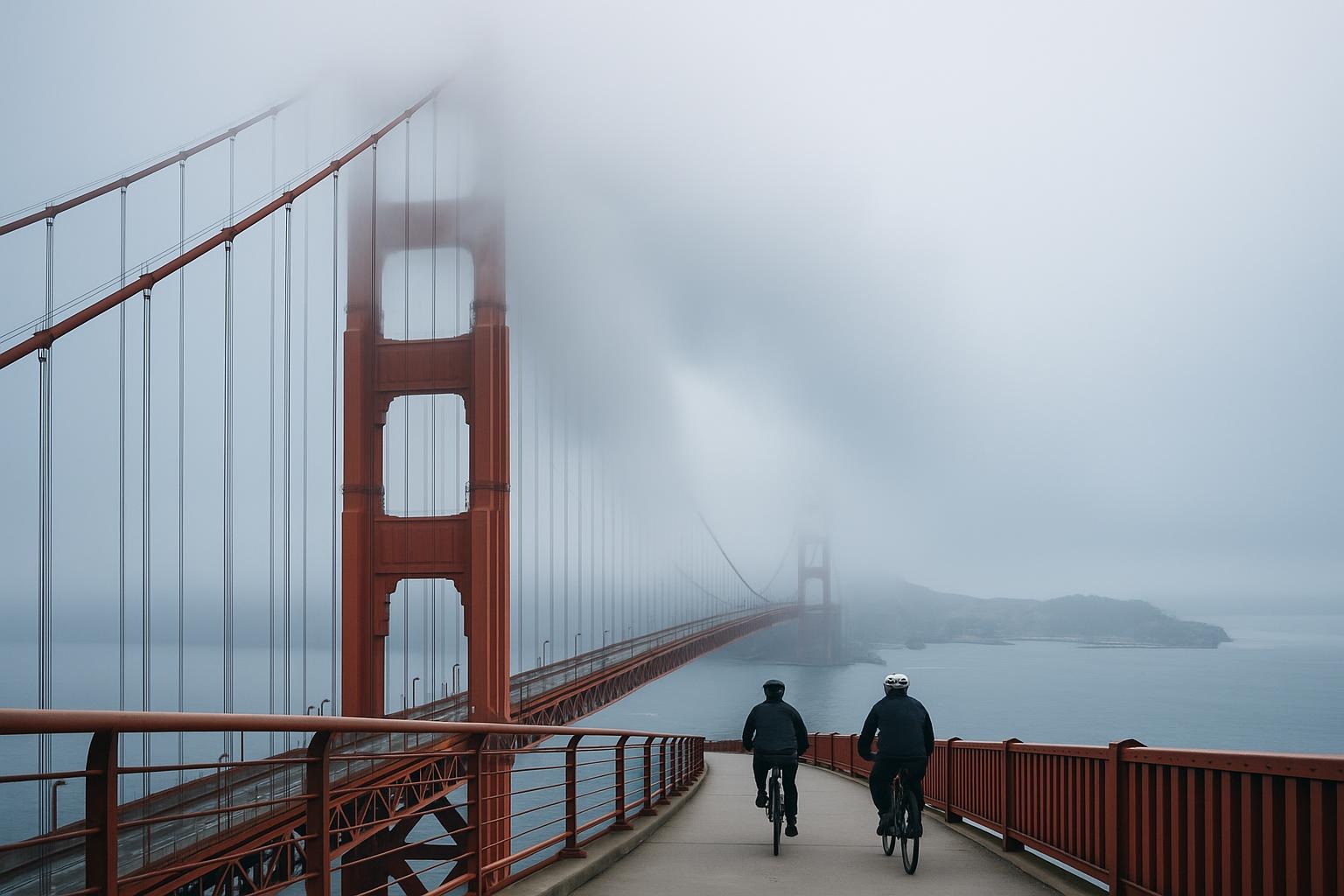
Fog pouring through the towers, two wheels, and nothing between you and Sausalito but a mile and three-quarters of wind.
There is a right way to see the Golden Gate Bridge, and it is from a bicycle. Rent bikes at Fisherman's Wharf around nine, ride west along the Marina Green and Crissy Field with the bridge growing in front of you, climb the one real hill to the bridge deck, and cross it — a mile and three-quarters of wind, fog, and the strange vertigo of the towers going up into cloud. On the far side the road drops through the Marin headlands into Sausalito, a fishing village turned artists' colony that hangs on the hillside like a Ligurian town. Lunch on the water, a wander past the houseboats at the north end, and then the ferry back across the bay to the Ferry Building with the bikes stowed on deck: a half hour of skyline and Alcatraz for the price of a bus fare. Sausalito is a must, and this is the only day it fits.
Return the bikes and spend the afternoon on the north side of the city — the Presidio's Tunnel Tops park for the picnic-blanket view of the bridge you just rode, and the Palace of Fine Arts, a Beaux-Arts ruin built for the 1915 fair and never meant to last. Then a short ride south to Alamo Square, where the row of Victorian "Painted Ladies" sits in front of the downtown skyline exactly the way it did in the opening credits of Full House. The evening belongs to the Mission: Dolores Park at golden hour, the murals in Clarion Alley, and dinner on Valencia Street, where the city's best kitchens have been for fifteen years.
Insider Notes
- Take the ferry back rather than riding the bridge twice. The ride into Sausalito is downhill; the ride out is the same hill in reverse with a headwind. The Golden Gate Ferry from Sausalito runs to the Ferry Building, carries bikes free, and is the best-value boat ride in the city.
- Be on the bridge before eleven. The fog usually burns off mid-morning and the wind picks up after lunch. The west sidewalk is for bikes on weekends; on weekdays, cyclists use the east side until 3:30.
- In Sausalito, walk the houseboats at Waldo Point Harbor — a floating neighborhood of four hundred homes, some of them converted ferries, that has been there since the 1960s. Respectful, quiet, and a ten-minute ride north of the ferry pier.
- Alamo Square is a park, not a museum. The classic photograph is taken from the top of the slope on the east side, looking down at the houses with the skyline behind. Late afternoon puts the sun on the facades.
- The Mission is where San Francisco eats now. Book dinner a week ahead; the good rooms on Valencia and 18th are small. Dolores Park at sunset on a warm day is the closest the city gets to a beach.
- Cavallo Point option. If you chose the Sausalito lodge for tonight, ride there directly from the bridge with the bags sent ahead by car, and take the ferry into the city tomorrow morning for Alcatraz.
Where to Eat
- Lunch — Bar Bocce on the Sausalito waterfront, pizza and salads at picnic tables on the sand, or Fish. at the harbor for the crab roll and a view of the boats. Both casual, both worth the ride.
- Dinner — Che Fico on Divisadero: Roman-Jewish and Californian at once, loud, delicious, and one of the hardest tables in the city. Book the day reservations open.
- Alternative — Flour + Water on Harrison for the pasta tasting, or Foreign Cinema in the Mission, where films play on the courtyard wall while you eat.
- Sundowner — Trick Dog on 20th Street, whose cocktail menu changes theme every six months and has been the best bar in the Mission for a decade. Or a bottle in Dolores Park, which is what the neighborhood does.
Tickets & Costs
| Bike rental, full day (Blazing Saddles or Bay City Bike), per person | $40–55 |
| Golden Gate Ferry, Sausalito to San Francisco, bikes free, per person | $14–15 |
| Presidio Tunnel Tops and Palace of Fine Arts | Free |
| Alamo Square and the Painted Ladies | Free |
Day 3 · San Francisco
Alcatraz, the Crooked Street, and the Ocean's Edge
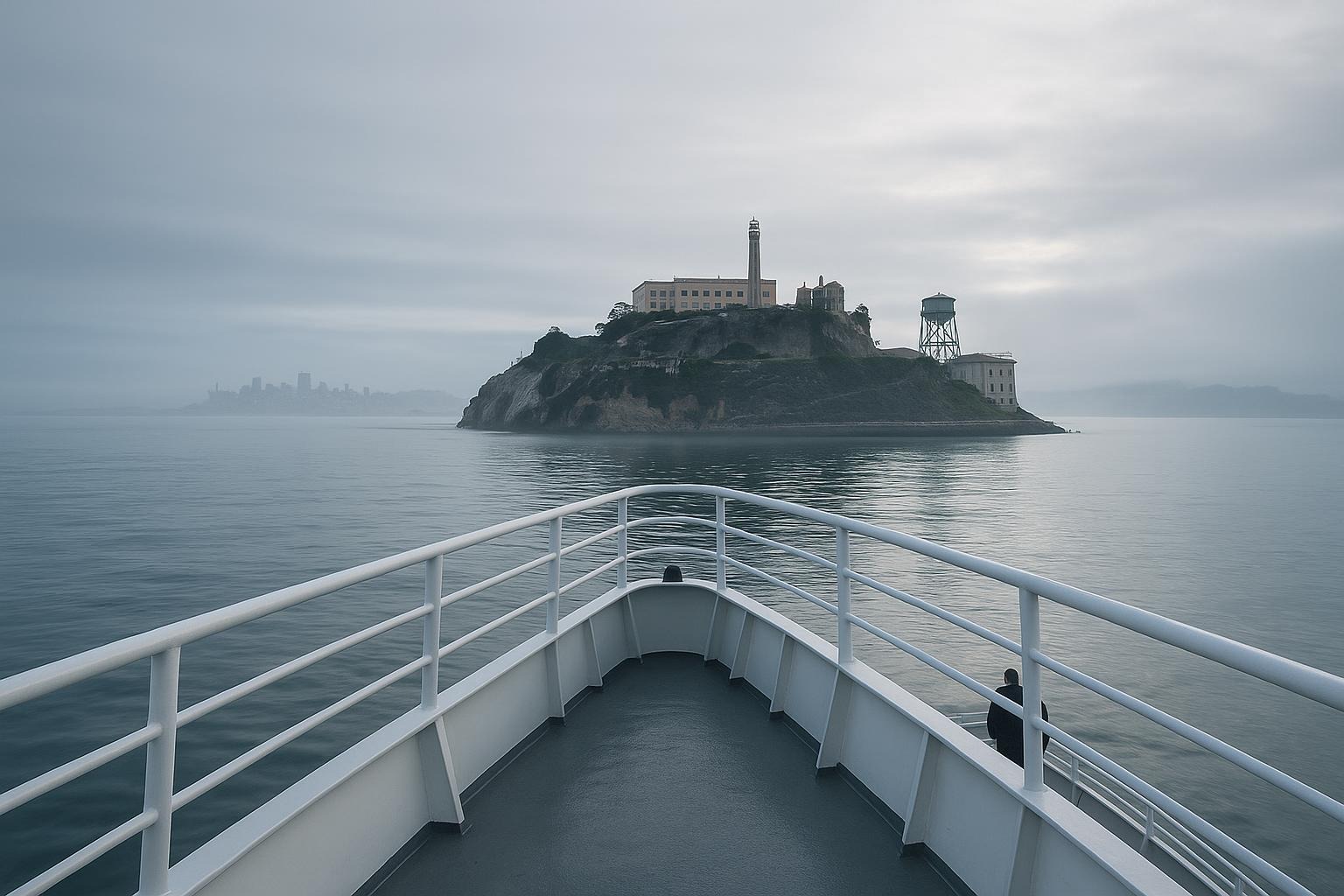
The Rock from the first boat of the morning, while the fog still has the bay to itself.
Alcatraz is still the most bucket-list thing in San Francisco, and it deserves the first boat of the morning: the island is quiet, the fog is often still on the water, and the cellhouse audio tour — narrated by former guards and inmates — lands harder before the crowds arrive. Two and a half hours is enough. The boat lands you back at Pier 33 by late morning, and from there the day unfolds west and uphill: along Fisherman's Wharf to the Hyde Street pier, then the Powell–Hyde cable car up to the top of Lombard Street, where you step off and walk down the eight hairpin turns of the "crookedest street in the world" with the bay laid out beyond the hydrangeas. Drift down into North Beach and Chinatown from there — the fortune cookie factory in Ross Alley, City Lights, a dim sum lunch — and you will have covered the city's postcard without once queuing for a photograph.
The afternoon is a choice, and you should make it rather than attempt both. Golden Gate Park — the de Young's observation tower (free, and the best view in the park), the Japanese Tea Garden, the bison paddock — is the gentle option. Lands End is the dramatic one: a clifftop trail through cypress from the Legion of Honor to the ruins of the Sutro Baths, with the bridge appearing around the headland and the Pacific breaking below, timed to finish at sunset. Either way, dinner is on the west side of town, where the neighborhoods are quieter and the kitchens are just as good.
Insider Notes
- Alcatraz tickets are sold only by Alcatraz City Cruises, and only in advance. Anyone selling them on the Embarcadero is selling a bay cruise that passes the island. Already been? Take the Night Tour instead — the same island, half the people, and a genuinely different experience after dark.
- Wear proper shoes and a layer; the island is windy and the walk from the dock to the cellhouse is steep. The ferry ride is fifteen minutes each way and the return boats run every half hour — you are not tied to a slot going back.
- The cable car queue at Powell and Market can be an hour. Board instead at the Hyde and Beach turnaround by the Wharf — shorter lines, and the Hyde Street hill is the most dramatic drop on the system. Lombard is the fourth stop.
- Lombard Street is best walked down, not driven. The cars queue for an hour to crawl the turns; the sidewalk stairs take five minutes and give you the bay view at every landing.
- Choose Lands End for the group, Golden Gate Park for the couple with tired legs. The Lands End trail is about three miles round trip with some steps; the park is flat and has cafés.
- The Painted Ladies, Lombard and the cable cars are all busiest between noon and three. This itinerary hits each of them earlier or later on purpose.
Where to Eat
- Lunch — dim sum at Good Mong Kok on Stockton Street: a takeout window with a line, cash only, the best pork buns in Chinatown for a few dollars — eaten in Portsmouth Square with the tai chi and the card games.
- Dinner — Nopa on Divisadero, the restaurant that made the neighborhood: wood-fired everything, a pork chop that has been on the menu since 2006, and a room that is still full at eleven. Or State Bird Provisions on Fillmore, where the food comes past on dim sum carts and every plate is a surprise.
- Alternative — Zuni Café on Market Street for the roast chicken for two, ordered when you sit down because it takes an hour, and the best Caesar in the city while you wait.
- Sundowner — the Sutro Baths ruins at Lands End as the sun goes into the Pacific, or — if you chose the park — a drink on the terrace at the Beach Chalet across from Ocean Beach, watching the surfers give up for the day.
- For the group — a Giants game at Oracle Park or the Warriors at Chase Center if the season lines up, then cocktails at Pacific Cocktail Haven.
Tickets & Costs
| Alcatraz Day Tour, per person | $45 |
| Alcatraz Night Tour, per person | $56 |
| Cable car, single ride | $8 |
| de Young Museum (the tower is free without a ticket) | $20 |
| Japanese Tea Garden | $15 |
| Lands End trail and Sutro Baths | Free |
More San Francisco?
The four-day San Francisco itinerary adds a Marin day — Watershed, Mount Tamalpais and Muir Woods — and a coast day down to Half Moon Bay that most visitors never make. Add a night to this route and follow it from there.
Day 4 · Sonoma
Over the Bridge to Wine Country
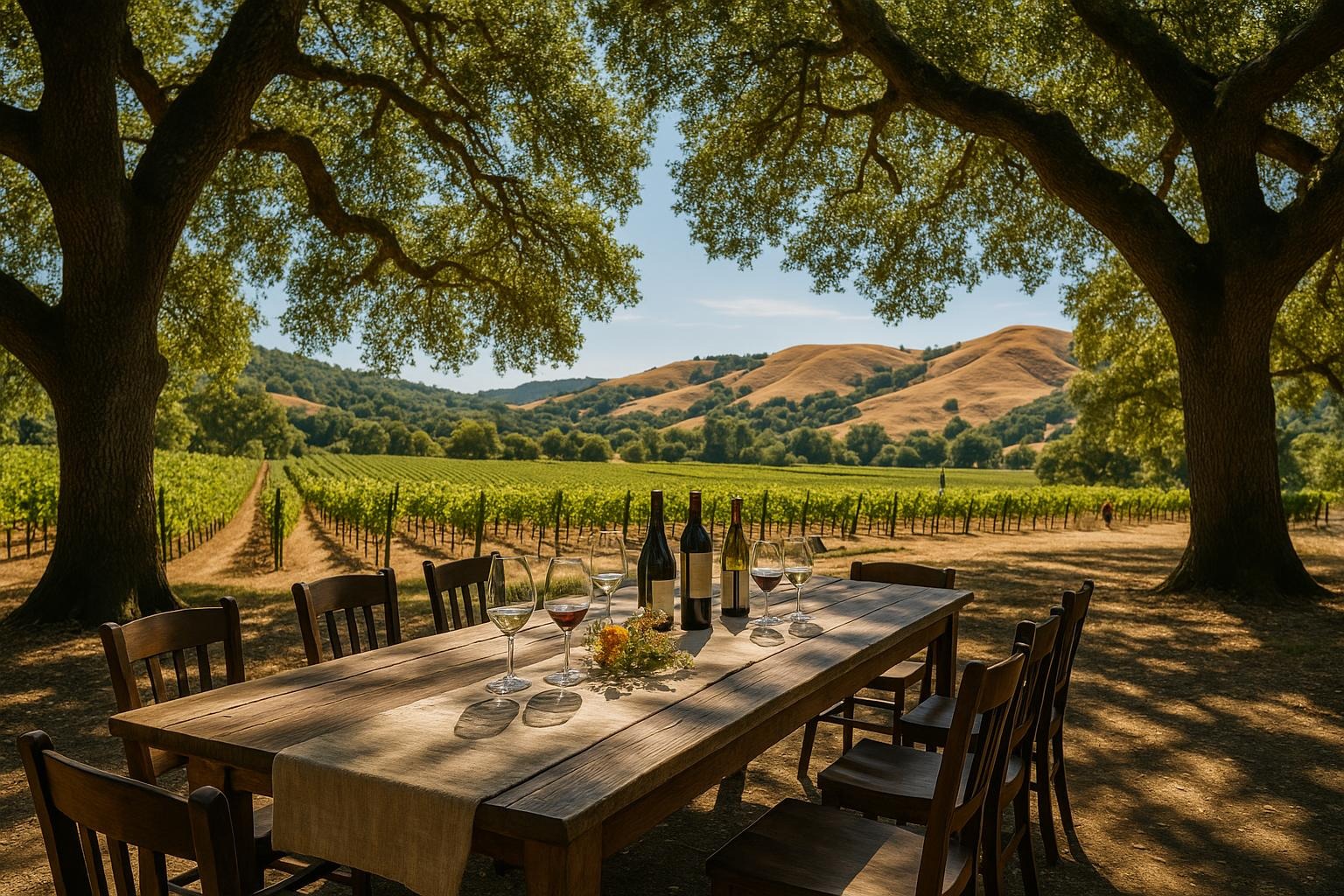
A long table under the oaks, the valley going gold, and nowhere you need to be.
Collect the car downtown after breakfast and drive north over the Golden Gate Bridge — toll-free in this direction — and into Marin. Twenty minutes past the bridge, pull off at Mill Valley for brunch at Watershed, a wood-fired California kitchen in the restored 1892 Lumberyard, where the deck hangs over a creek and Mount Tamalpais fills the sky behind it. It is the kind of place that makes you understand why nobody who lives here ever leaves. Then Highway 101 north to Highway 37 across the top of the bay and Highway 121 through the Carneros vineyards into Sonoma — about forty-five minutes, and the first real wine country of the trip.
Sonoma is Napa's quieter, cooler sibling: the same soils, a fraction of the traffic, and tasting rooms where the person pouring is likely to be the winemaker's daughter. Build the afternoon around three appointments — Scribe, in a restored 1858 hacienda above the town, is the most beautiful setting in the valley; Gundlach Bundschu is the oldest family winery in California and the most fun; Three Sticks pours in an 1842 adobe on the Plaza. Then a swim, a nap, and dinner in Glen Ellen, a village of a few hundred people with one of the best restaurants in the county.
Where to Stay · Sonoma Valley, one night
Sleep here, not in Napa — it keeps the drive south simple.
The Classic
$300–400 a night- Olea Hotel, Glen EllenCouple's pickFifteen rooms and cottages among the oaks, a serious breakfast, and total quiet.
- The Lodge at Sonoma Resort, Autograph CollectionFor fourSpanish-style grounds, pool and spa five minutes from the Plaza; easy for a group.
- Inn at SonomaRight on the Plaza, wine hour every evening, the best value in the valley.
The Elevated
$600–1,000 a night- Farmhouse Inn, ForestvilleThe Russian River's finest: a Michelin-starred restaurant, a spa, and rooms with fireplaces. Forty minutes further north and worth it.
- The Madrona, HealdsburgAn 1881 mansion reimagined as a design hotel with a knockout restaurant; puts SingleThread and the Healdsburg Plaza in reach.
- MacArthur Place Hotel & Spa, SonomaGarden suites a five-minute stroll from the Plaza, for luxury without the drive.
Insider Notes
- The Golden Gate Bridge is tolled southbound only, and it is all-electronic — there is no booth. You pay nothing today. Tomorrow, coming back into the city from Sonoma, the toll will be billed to the rental car's plate and the rental company will add a fee; pay it yourself online at goldengate.org within 48 hours of crossing and you avoid the surcharge.
- Book Watershed. Weekend brunch in Mill Valley is a local institution and the deck fills by ten. Twenty minutes from the bridge, and directly on the way.
- Tasting appointments are the norm in Sonoma now, not the exception. Scribe in particular books out weeks ahead; Gundlach Bundschu and Three Sticks a few days. Three tastings is the right number — a fourth is where the day gets away from people.
- A designated driver, or a driver. Sonoma Valley Bike Tours will pedal you between wineries on the flat valley floor; a private driver for the afternoon runs $75 to $100 an hour and is the civilized answer for four.
- Ship the wine, don't carry it. Every winery will ship a case home for you; the one-way rental has six more days of luggage to absorb.
- Healdsburg or Sonoma? Healdsburg is prettier, pricier and forty minutes further north, and it adds an hour to tomorrow's drive. For one night, Sonoma town and Glen Ellen are the right answer unless the Farmhouse Inn or SingleThread is the reason you came.
Where to Eat
- Brunch — Watershed in the Mill Valley Lumberyard: wood-fired pizzas, the Stemple Creek burger, a BLAT on Parkside sourdough — on the creekside deck.
- Dinner — Glen Ellen Star, a tiny wood-fired kitchen in a 1940s cottage where the vegetables from the oven are as good as the pork. Book ten days ahead.
- Alternative — The Girl & the Fig on Sonoma Plaza for the French-Californian classic, or Layla at MacArthur Place for a more polished room. Staying in Healdsburg: Valette, or SingleThread if you booked it months ago.
- Sundowner — the terrace at Scribe if your tasting runs late, or a glass of Gundlach Bundschu's Gewürztraminer on your own porch as the valley goes gold. Sonoma's evenings are long and warm; do not waste one in a bar.
Tickets & Costs
| One-way rental car, 7 days, mid-size, including drop fee | $900–1,300 |
| Scribe Winery tasting, per person | $50–75 |
| Gundlach Bundschu tasting, per person | $35–60 |
| Three Sticks, The Adobe tasting, per person | $75–95 |
| Sonoma Valley Bike Tours, half day, per person | $150–180 |
| Golden Gate Bridge toll (southbound only, pay online within 48 hrs) | $10 |
Day 5 · Carmel-by-the-Sea
The Long Way Down the Coast
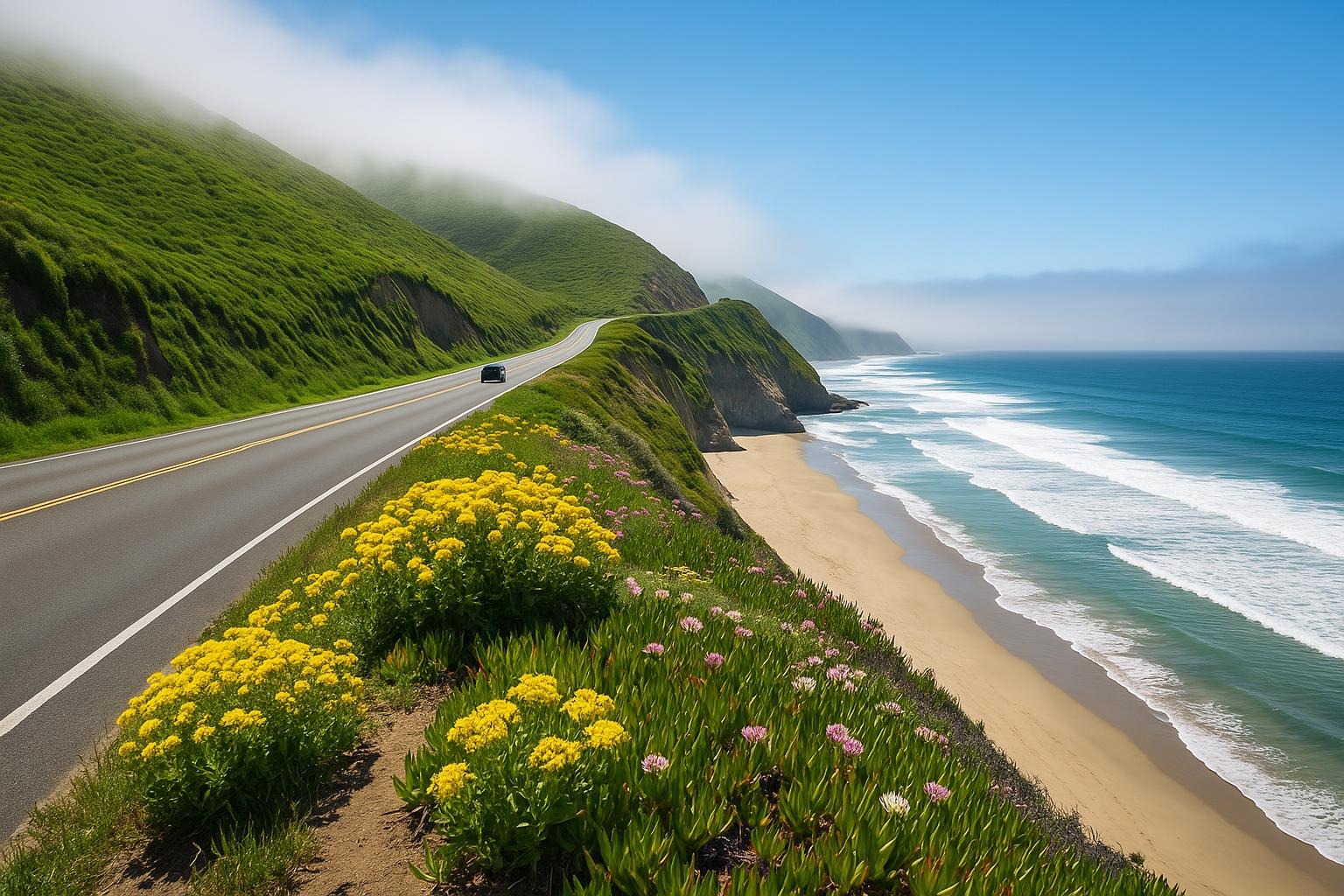
Where the road finally finds the ocean — and does not let go of it for four hundred miles.
Today the road trip begins in earnest, and you should take the long way. The fast route from Sonoma to Carmel is three hours of freeway; the coast route is four hours of driving spread across a whole day, and it is the first reason you came. Back south over the Golden Gate, straight through the city, and onto Highway 1 at Pacifica, where the road threads the Devil's Slide cliffs and drops to Half Moon Bay for lunch on the harbor. From there the highway runs south past pumpkin fields and the Pigeon Point lighthouse — the tallest on the West Coast — into Santa Cruz, where West Cliff Drive gives you surfers, sea lions and the old boardwalk from the car window.
The last hour curves around the top of Monterey Bay. At Moss Landing, Elkhorn Slough is the best place in California to see sea otters from the roadside, rafts of them floating on their backs in the harbor mouth. Then Monterey, and the short hop over the hill into Carmel-by-the-Sea: a storybook village of cottages and galleries with no street addresses and no traffic lights, built along one of the most beautiful beaches in the state. Check in, and walk down Ocean Avenue to the sand for sunset — the whole town shows up with dogs and wine, and so should you.
Where to Stay · Carmel-by-the-Sea, two nights
Point Lobos, Pebble Beach and Big Sur are all within thirty minutes.
The Classic
$300–400 a night- La Playa CarmelThe 1905 grande dame two blocks from the beach; champagne and cheese at check-in, breakfast on the terrace.
- Cypress InnDoris Day's Spanish-Moorish inn, dog-friendly, with the liveliest lounge in the village — the most Carmel of Carmel hotels.
- Hofsas HouseFor fourFamily-run, ocean-view balconies, and family suites that sleep four comfortably at the best price in town.
The Elevated
$600–1,000 a night- L'Auberge CarmelCouple's pickA twenty-room Relais & Châteaux with Aubergine, the Michelin-starred restaurant, downstairs. The splurge.
- Bernardus Lodge & Spa, Carmel ValleyVineyard sunshine (it is ten degrees warmer than the coast), a serious spa and Lucia restaurant.
- Carmel Valley RanchFor fourFive hundred acres, golf, a lavender farm, and two-bedroom suites built for a group.
- Glen Oaks Big SurWildcardMid-century cabins in the redwoods forty minutes south. If the road is open, swap the second night here so that you wake up in Big Sur.
Insider Notes
- Leave Sonoma by nine. With lunch and stops, the coast route lands you in Carmel around five, in time for the beach. Leave at eleven and you will be driving the last hour in the dark, which wastes the best part.
- Pay the bridge toll online today — see Day 4. Southbound over the Golden Gate is the one tolled crossing of the whole trip.
- Pigeon Point is a working lighthouse and a hostel. The grounds are free, the views south are the best on this stretch, and there are whales offshore from December to April.
- Elkhorn Slough otters are visible from the parking lot at the Moss Landing harbor. With an extra hour, Monterey Bay Kayaks rents boats here and you will be among the otters in ten minutes — the best wildlife experience on the coast for the price of a bike rental.
- Carmel has no street addresses. Directions are given by cross streets ("Dolores, between Fifth and Sixth"), houses have names, and your rental car's GPS will need the hotel's coordinates. Park once; the village is six blocks square.
- Carmel Beach allows dogs off-leash and wine at sunset, which tells you most of what you need to know about the town.
Where to Eat
- Lunch — Sam's Chowder House at Half Moon Bay harbor: the lobster roll is the reason people drive here from the city, at a table on the deck. Or Duarte's Tavern in Pescadero, twenty minutes south, for artichoke soup in an 1894 saloon.
- Dinner — La Bicyclette on Dolores: French-Italian, wood-fired, thirty seats, no pretension — the quintessential Carmel dinner. Book ahead.
- Alternative — Cultura Comida y Bebida, hidden in a courtyard, for Oaxacan food and the best mezcal list on the peninsula.
- Sundowner — the sand at the foot of Ocean Avenue with a bottle from Carmel's own Scheid or Caraccioli tasting rooms. This is the ritual; the village does it every night.
Tickets & Costs
| Golden Gate Bridge toll, southbound | $10 |
| Pigeon Point Lighthouse grounds | Free |
| Monterey Bay Kayaks, Elkhorn Slough rental, 2 hours, per person | $45–60 |
| Carmel hotel parking | Usually free |
Day 6 · Carmel & Pebble Beach
Point Lobos, 17-Mile Drive, and the Bagpiper
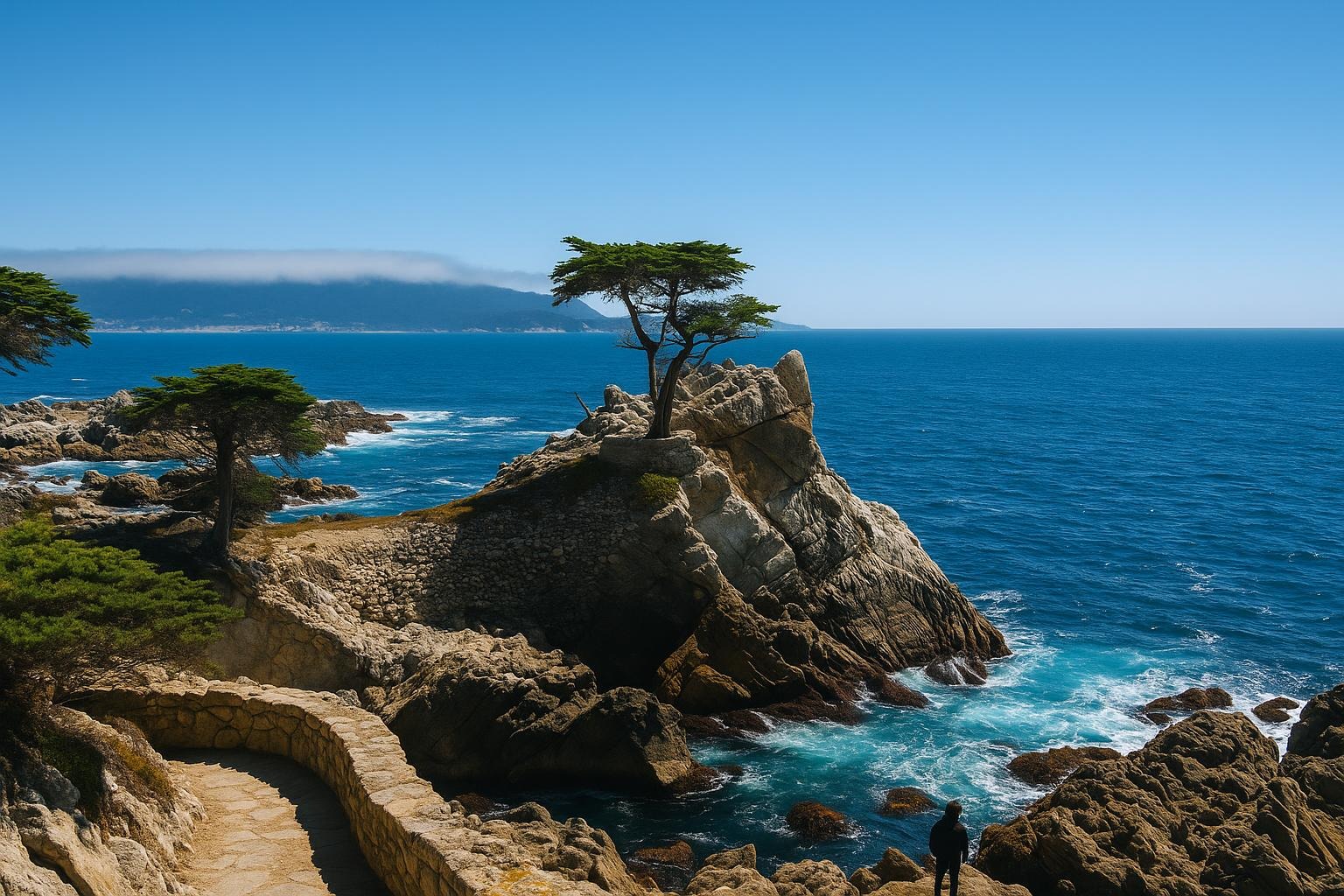
The Lone Cypress, two and a half centuries on its rock, still leaning into the Pacific.
Be at Point Lobos when the gate opens at eight. This is the finest coastal walk in California — a state reserve of cypress-covered headlands, jade-green coves, sea lions barking on the rocks and, in season, whales passing so close you can hear them breathe — and by ten the small parking lot is full and the road outside lined with cars. Two hours on the Cypress Grove and Sea Lion Point trails is enough, and it sets the standard for everything that follows.
Then 17-Mile Drive, and the instruction here is simple: stop at every marked vista point on the map they hand you at the gate. Enter at the Carmel gate and drive the loop north so the day ends at Spanish Bay — Pescadero Point and its ghost trees, the Lodge at Pebble Beach for lunch over the 18th green, the Lone Cypress, Crocker Grove, Cypress Point, Fanshell Overlook, Seal Rock, Bird Rock, China Rock, Point Joe, the Restless Sea. The light changes at every turn and none of them is skippable. Give the afternoon to Carmel's galleries — roughly a hundred of them packed into one square mile — and then drive back through the forest to The Inn at Spanish Bay for the evening this whole itinerary was built around.
Every evening, rain or shine, a bagpiper starts on the first tee of the Links at Spanish Bay and plays the golf course to sleep, walking the fairways up to the fire pits outside the Lobby Lounge — about forty-five minutes, finishing beside the terrace as the sun goes into the Pacific. During daylight saving time the piper starts around 5:45pm; in winter, half an hour before sunset. The tradition began in 1987, after Tom Watson remarked that the course felt so Scottish you could almost hear the bagpipes. Take a drink and a blanket to the fire pits forty-five minutes early. Nothing else on the California coast is like it.
Insider Notes
- Point Lobos parking is the whole game. The lot holds about 150 cars and fills on weekends by 9:30; when it is full you park on the highway shoulder and walk in, which adds a mile. Eight o'clock, no exceptions.
- 17-Mile Drive charges a small entry fee per car, refunded against a tab of $35 or more at any Pebble Beach restaurant — which lunch at The Bench covers. Motorcycles are not allowed at all.
- Fanshell Overlook and Cypress Point Lookout close from April through May for harbor seal pupping. The rest of the loop stays open.
- The galleries are the afternoon's real business. Start at the Carmel Art Association on Dolores, artist-run since 1927; Weston Gallery on Sixth for photography (the Weston and Adams legacy lives here); Winfield Gallery; Dawson Cole Fine Art for Richard MacDonald's bronzes; Gallery Sur for Big Sur landscapes. If your dates land on the monthly Saturday-evening Art Walk, the galleries pour wine.
- At Spanish Bay, sit at the fire pits on the Lobby Lounge terrace, not inside. Staff bring blankets; the wind off the dunes is real. There is no cover charge and you need not be a guest — order a drink and you are welcome.
- If Big Sur is closed south of the village, make today the Big Sur out-and-back instead — Bixby Bridge, Pfeiffer Beach, lunch at Nepenthe, McWay Falls if it is reachable — and fold the Peninsula into a slower morning on Day 7.
Where to Eat
- Lunch — The Bench at The Lodge at Pebble Beach, on the terrace over the 18th green and Stillwater Cove: wood-fired flatbreads and the best-located lunch in California. The tab refunds your gate fee.
- Dinner — Chez Noir, a Michelin-starred neighborhood bistro in a Carmel cottage that is the hardest reservation on the peninsula. Book the day the calendar opens. Or Roy's at Pebble Beach at the Inn itself, so the bagpiper flows straight into dinner.
- Alternative — Aubergine at L'Auberge Carmel, the tasting-menu splurge, for an anniversary dinner.
- Sundowner — the fire pits at The Inn at Spanish Bay, a glass of Monterey County pinot, and the bagpiper coming up the fairway. This is the one.
Tickets & Costs
| Point Lobos State Natural Reserve, per vehicle | $10 |
| 17-Mile Drive, per vehicle (refunded with a $35 restaurant tab) | $12.25 |
| Carmel galleries and Art Walk | Free |
| Carmel Mission Basilica, if added | $13 |
| Drinks at the Spanish Bay fire pits, per cocktail | $18–25 |
A third Carmel night?
Many clients add one. The morning goes to the early bike ride along the Monterey Bay Coastal Trail, the Aquarium at opening, and a late-afternoon walk up Jacks Peak for the view of the whole peninsula. That day is written in full in the three-night Monterey Peninsula itinerary.
Day 7 · Big Sur to the Santa Ynez Valley
The Drive Itself
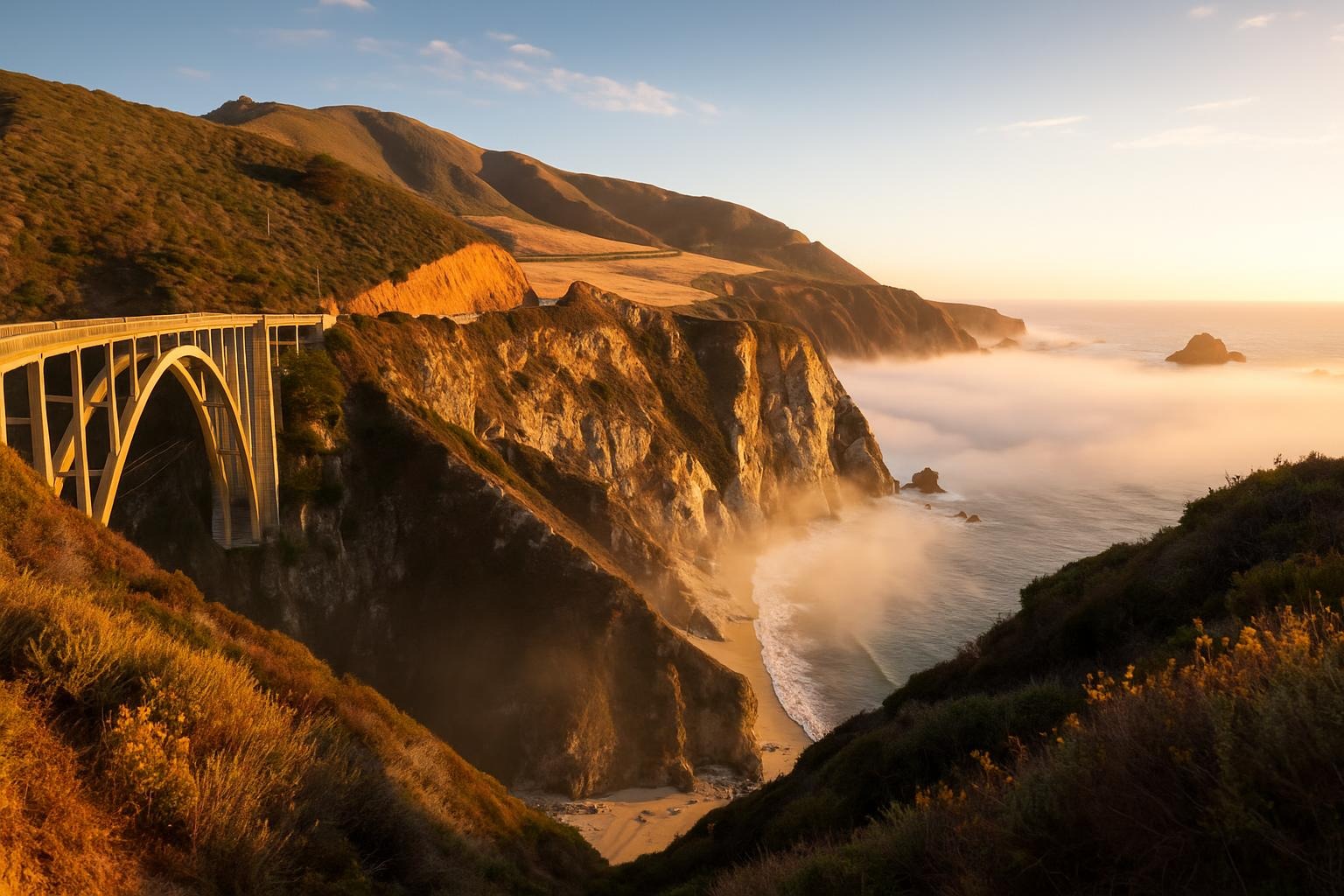
Bixby Bridge at eight in the morning — the hour it belongs only to you.
This is the day the whole trip is named for. Leave Carmel by eight, with coffee in hand, and within twenty minutes the road climbs out of the pines and onto the cliffs of Big Sur — ninety miles of the Santa Lucia Mountains falling straight into the Pacific, with Highway 1 cut into the face between them. Bixby Bridge first, from the turnout on the north side, while the light is low and the tour buses are still in Monterey. Then Pfeiffer Beach, down an unmarked lane, for the purple sand and the keyhole rock; coffee at Big Sur Bakery; and lunch on the terrace at Nepenthe, eight hundred feet above the water, where Orson Welles once bought a cabin for Rita Hayworth. McWay Falls, an eighty-foot ribbon dropping onto a beach you cannot reach, is ten minutes south, and after it the road empties out — Lucia, Ragged Point, and the long straight run past the elephant seals at Piedras Blancas to Hearst Castle and Cambria.
From Cambria you have a choice. Pismo Beach is an hour on — a surf town with a pier, clam chowder in bread bowls and the best beach-hotel value on the coast, if what you want tonight is sand. The Santa Ynez Valley is two hours on, over the hills into a Danish village and the vineyards of Los Olivos, if what you want is one more wine-country night and the best hotel between Carmel and Los Angeles. This itinerary sleeps in the valley. Pismo is written below for those who choose the beach.
Plan B · If the road is closed
Highway 1 through Big Sur reopened in full in January 2026 after nearly three years of slide closures, and it closes again — for slides in winter, for fires in late summer — with little notice. Search Caltrans QuickMap for "Highway 1 Big Sur" the night before. If the road is shut south of the village, do Big Sur as an out-and-back to Bixby, Pfeiffer Beach and Nepenthe this morning, then take Highway 101 south through Salinas to Paso Robles — lunch and tastings at Tin City, a detour to Morro Rock — and on to Pismo or the valley by late afternoon. The day still works.
Where to Stay · The Santa Ynez Valley, one night
The itinerary's choice: a Danish village, the Los Olivos wine scene, and the best stay south of Carmel.
The Classic
$300–400 a night- Hotel Ynez, SolvangCouple's pickBoutique and adults-oriented, with fire pits and an outdoor bar.
- The Landsby, SolvangScandinavian-modern rooms and a good restaurant, walkable to the bakeries.
- Sideways Inn, BuelltonYes, that one from the film. Fun, affordable, and next door to the Hitching Post.
The Elevated
$600–1,000 a night- The Inn at Mattei's Tavern, Auberge Resorts Collection, Los OlivosAn 1886 stagecoach stop turned Auberge resort: bungalows, a pool under the oaks, and a tavern worth the trip alone. The single best stay between Carmel and Los Angeles.
- Alisal Ranch, SolvangFor fourA 10,000-acre working ranch with horseback rides, a private lake and cottages that suit four friends perfectly.
Or · Pismo Beach, one night
Choose it if you want sand and simplicity. Saves an hour of driving today, adds it tomorrow.
The Classic
$300–400 a night- Vespera Resort on Pismo Beach, Autograph CollectionThe newest and most polished hotel in town, right on the sand with a fire-pit lawn.
- Inn at the PierRooftop bar over the pier, walkable to everything.
- The Madonna Inn, San Luis ObispoWildcard110 themed rooms of gloriously over-the-top kitsch, fifteen minutes inland. A group of friends will talk about it for years.
The Elevated
$500–800 a night- Dolphin Bay Resort & Spa, Shell BeachBluff-top one- and two-bedroom suites with full kitchens and ocean terraces. The only true luxury stay on this stretch — the ceiling is lower here.
Insider Notes
- Fuel up in Carmel. There is one gas station in Big Sur and it charges accordingly. Cell service disappears for most of the ninety miles; download the maps.
- Pfeiffer Beach is not signposted. The turn is Sycamore Canyon Road, two miles of narrow single lane, one mile south of the Pfeiffer Big Sur State Park entrance. Day-use fee at the bottom; the purple sand is at the north end of the beach.
- Hearst Castle needs a booked tour; the Grand Rooms tour is the one to take on a first visit, about an hour and a half including the bus up the hill. The elephant seals at Piedras Blancas, four miles north, are free and best from December to March when the beach is a battlefield.
- The "top down" moment is the stretch between Ragged Point and Cambria — straight, empty, and warm once you are south of the fog line.
- Nepenthe does not take reservations for the terrace. Arrive before noon or after two; the wait at one o'clock on a Saturday is an hour, and the view is worth it anyway.
- Solvang adds about an hour of driving today and saves it tomorrow. Pismo is the reverse. Either way, tomorrow's lunch in Santa Barbara is on the road.
Where to Eat
- Lunch — Nepenthe, on the terrace: the Ambrosia burger, the view, and a glass of something local. Or Big Sur Bakery for a slower breakfast-into-lunch under the redwoods.
- Dinner, in the valley — The Tavern at Mattei's, in the 1886 stagecoach inn: prime rib, wood-grilled fish, an extraordinary Santa Barbara County wine list. Or Bell's in Los Alamos, a Michelin-starred French bistro in an 1880s storefront, for the prix fixe. Book both well ahead.
- Dinner, in Pismo — Oyster Loft over the pier, or Ventana Grill on the cliffs at Shell Beach, for sunset over the water.
- Sundowner — the pool under the oaks at Mattei's, or — in Pismo — the fire pits on the lawn at Vespera with the pier lit up below.
Tickets & Costs
| Pfeiffer Beach day-use, per vehicle | $15 |
| Julia Pfeiffer Burns State Park (McWay Falls), per vehicle | $10 |
| Hearst Castle, Grand Rooms tour, per person | $30 |
| Piedras Blancas elephant seal rookery | Free |
| Tin City tastings, Paso Robles (Plan B), per person | $25–40 |
| Los Olivos tasting rooms, per person | $25–40 |
Day 8 · Santa Monica
Santa Barbara, Malibu, and Venice by Bike
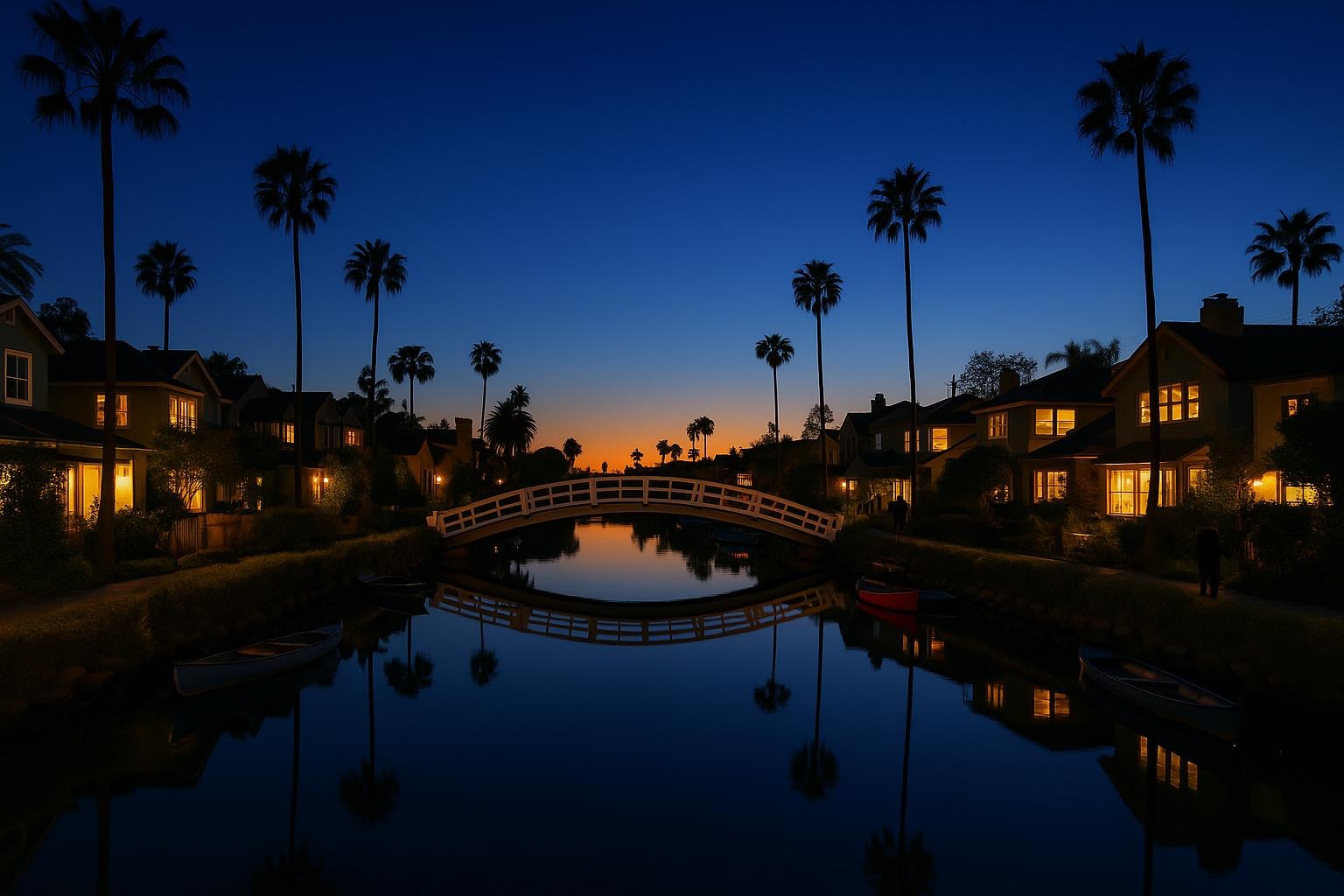
Blue hour on the Venice Canals, when the footbridges double in the water and the city goes quiet.
South on the 101 through the Gaviota pass, and the coast turns Mediterranean: Santa Barbara, with its red roofs and white walls, is the right place for lunch — the Funk Zone, a former warehouse district by the beach that is now tasting rooms and tapas. From Oxnard, leave the freeway and drop onto Pacific Coast Highway for the twenty-seven miles of Malibu: Point Mugu's rock, the sea caves of El Matador at low tide, the surfers at Zuma, and the pier where the road finally turns into the city. Check in on the sand in Santa Monica by mid-afternoon.
Then go to Venice the right way, on bicycles along the beach path. The Marvin Braude trail runs from the Santa Monica pier south along the sand into the boardwalk carnival of Venice — Muscle Beach, the skatepark, the drum circles — and inland to the canals, four blocks of footbridges and cottages left over from a 1905 fantasy of Italy. Abbot Kinney Boulevard is a few streets over, and it is where you eat: a mile of boutiques and the restaurants that made this neighborhood the best food address on the Westside. A sundowner on the rooftop at Hotel Erwin, dinner on Abbot Kinney, and a ride or a car back up the coast to bed.
Where to Stay · Santa Monica, one night
Venice by day, Santa Monica by night — see the first insider note for why.
The Classic
$300–400 a night- Palihouse Santa MonicaA 1927 courtyard building a block from the beach on the quiet, residential north side of town; Montana Avenue's cafés around the corner.
- Marina del Rey HotelFor fourOn the water in the marina with a pool deck over the boats; ten minutes to Venice by bike, and the value play for a group.
- Hotel Erwin, VeniceThe only real hotel on the boardwalk, and the High Rooftop Lounge at sunset is unbeatable. Right now we recommend it for the sundowner rather than the night.
The Elevated
$600–1,000 a night- Shutters on the BeachCape Cod on the Pacific; the classic.
- Hotel Casa del MarShutters' grand 1926 sister next door, slightly better value, same beach.
- Regent Santa Monica BeachThe newest luxury opening on this coast; a scene-y pool and a Michael Mina restaurant.
Insider Notes
- Why Santa Monica, not Venice. Venice is the most alive stretch of the Los Angeles coast by day, but encampments have returned to parts of the boardwalk and the streets around Rose Avenue in 2026, so this itinerary visits Venice in daylight and sleeps ten minutes up the beach path on the Santa Monica sand — at or south of the pier, well away from the Third Street Promenade where downtown's own street issues concentrate.
- Santa Barbara is a stop, not a night — on this route. It is a two-hour lunch: park at the beach, walk the Funk Zone, and leave by two so Malibu is in afternoon light.
- El Matador is only worth it at low tide. Check the tide table; at high water the sea caves and the arches are underwater and the beach is a strip. The lot is small and cash; parking on PCH's shoulder is legal where signed.
- PCH in Malibu is open but check for construction — the road has been under repair since the 2025 fires and lane closures come and go.
- Rent the bikes at the Santa Monica end, ride south to Venice, and ride back after dinner along the lit path — or leave the bikes and take a car. Do not walk the Venice boardwalk after dark.
- Book Gjelina or Felix the day the calendar opens. Abbot Kinney's rooms are small and the wait at eight on a Friday is real. Gjusta, Gjelina's bakery around the corner, is the no-reservation daytime alternative and one of the best lunches in Los Angeles.
Where to Eat
- Lunch — Loquita in Santa Barbara's Funk Zone: Spanish tapas, paella, gin-tonics, a block from the beach. Or Los Agaves on Milpas Street for the best tacos in the county.
- Dinner — Gjelina on Abbot Kinney, the vegetable plates and the pizzas that launched a thousand imitations — or Felix, for Evan Funke's hand-rolled pasta, the hardest table on the Westside.
- Alternative — Cassia in Santa Monica for Southeast Asian by way of California, or Élephante on Ocean Avenue if you would rather stay on the Santa Monica side with a view.
- Sundowner — High Rooftop Lounge at Hotel Erwin, five floors above the Venice boardwalk, with the sun going down behind the palms and the whole beach below. Arrive at six for a rail-side table.
Tickets & Costs
| Bike rental, Santa Monica, half day, per person | $30–50 |
| El Matador State Beach parking | $8–10 |
| Point Mugu, Zuma, Venice Canals, boardwalk | Free |
| Santa Monica hotel parking, per night | $45–65 |
| Pacific Park Ferris wheel, if the mood strikes | $12 |
The Los Angeles extension begins here
If you are adding four nights, tonight is Day 1 of the five-night Los Angeles itinerary — Beverly Hills, Universal, Malibu and Catalina follow, and you rejoin this route at Day 9. See the extension below.
Day 9 · San Diego
The Orange County Coast and Coronado
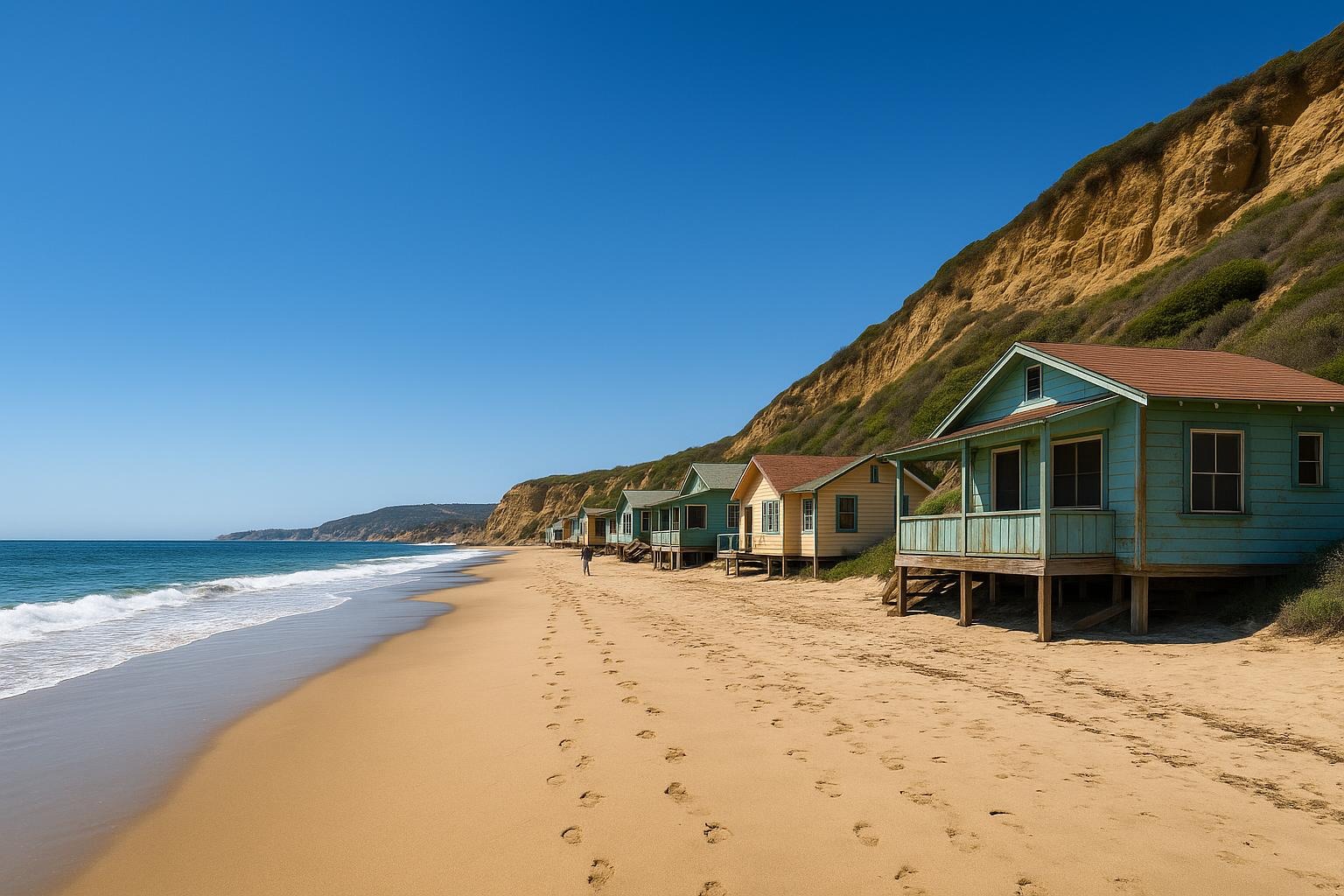
Crystal Cove, where the cottages still sit on the sand and the year is still 1935.
The direct route from Santa Monica to San Diego is two and a half hours of Interstate 5, and it is the one drive on this trip that has no redeeming features. So take the coast one last time. The 405 south to Newport Beach, then Pacific Coast Highway through Crystal Cove — three miles of undeveloped state beach with 1930s cottages on the sand — into Laguna Beach for lunch above the water, on through Dana Point and San Clemente, and only then onto the freeway for the last hour past Camp Pendleton and the North County beaches. It adds an hour and turns a transfer into a day.
Check into San Diego by mid-afternoon and cross the bridge to Coronado immediately. The two-mile arc of the Coronado Bridge is the best entrance the city has, and it drops you at the Hotel del Coronado — the 1888 wooden Victorian where Some Like It Hot was filmed — with the widest, flattest, most golden beach in California in front of it. Walk the sand, have a drink on the Del's Sun Deck, and go down to the Ferry Landing at sunset for the skyline across the bay. Dinner is back across the bridge in Little Italy, the most reliably good restaurant neighborhood in the city.
Where to Stay · San Diego, two nights
Downtown's street issues concentrate in East Village, east of about 10th Avenue. Every pick below is chosen with that in mind.
The Classic
$300–400 a night- The Lafayette Hotel & Club, North ParkFor fourA 1946 hotel reborn in 2023 as the city's most fun stay: a famous pool, five bars, live music.
- InterContinental San Diego, EmbarcaderoA bayfront tower with a rooftop pool over the harbor, walkable to Little Italy and the waterfront; the clean, central downtown choice.
- Tower23, Pacific BeachGlassy rooms on the boardwalk, surf outside the door.
The Elevated
$600–1,000 a night- Hotel del CoronadoThe 1888 Victorian icon on the best beach in the city, freshly restored; the Views and Shore House rooms sit at the top of the range.
- The Lodge at Torrey PinesCouple's pickA Craftsman lodge above the cliffs and the famous golf course.
- Alila Marea Beach Resort, EncinitasBluff-top Hyatt luxury thirty minutes north, with the coast's best sunset deck.
- Fairmont Grand Del MarA Mediterranean estate with golf and a serious spa, for a resort finish.
Insider Notes
- Leave Santa Monica by 9:30 to beat the traffic on the 405 and reach Laguna for a one o'clock lunch. Weekend afternoons on PCH through Laguna crawl; weekdays are fine.
- Crystal Cove's parking lots are the way in; the historic district cottages are a ten-minute walk down from the Los Trancos lot, and the Beachcomber Café there does a good breakfast if you are early.
- The Coronado Bridge is free and the views are on the driver's side heading over. On the island, park once at the Del and walk — Orange Avenue, the beach and the Ferry Landing are all within twenty minutes on foot.
- The Del's Sun Deck is open to everyone, not only guests. Fire pits, the beach in front, and the hotel's turrets behind: order the mai tai and sit facing west.
- Little Italy on a Saturday has the best farmers market in the city, 8am to 2pm along Date Street. On any night it is the neighborhood to walk after dinner; the Gaslamp is louder and rougher after eleven.
- Book Petco Park early. A Padres game (March to September) is the perfect last night for a group, and the park is a fifteen-minute walk from Little Italy.
Where to Eat
- Lunch — Driftwood Kitchen in Laguna Beach, built into the cliff over Main Beach, for fish tacos and a view straight down the coast you just drove. Or the Crystal Cove Shake Shack on PCH for a date shake at the counter, a local rite since 1946.
- Dinner — Born & Raised in Little Italy: a supper-club steakhouse of brass, velvet and tableside Caesars, with a rooftop that is the best-looking room in San Diego. Or Ironside Fish & Oyster, two blocks away, for the lobster roll and the raw bar.
- Alternative — Herb & Wood, also Little Italy, for wood-fired California cooking in a converted warehouse.
- Sundowner — the Coronado Ferry Landing at sunset, looking back across the bay at the skyline with the bridge arcing over the water. Then the Del's Sun Deck for the mai tai if you have not already had it.
Tickets & Costs
| Crystal Cove State Park parking | $15 |
| Coronado Bridge | Free |
| Hotel del Coronado Sun Deck, per cocktail | $18–22 |
| Padres game at Petco Park, if added, per person | $30–120 |
| San Diego hotel parking, per night | $35–60 |
Day 10 · San Diego
La Jolla to Point Loma
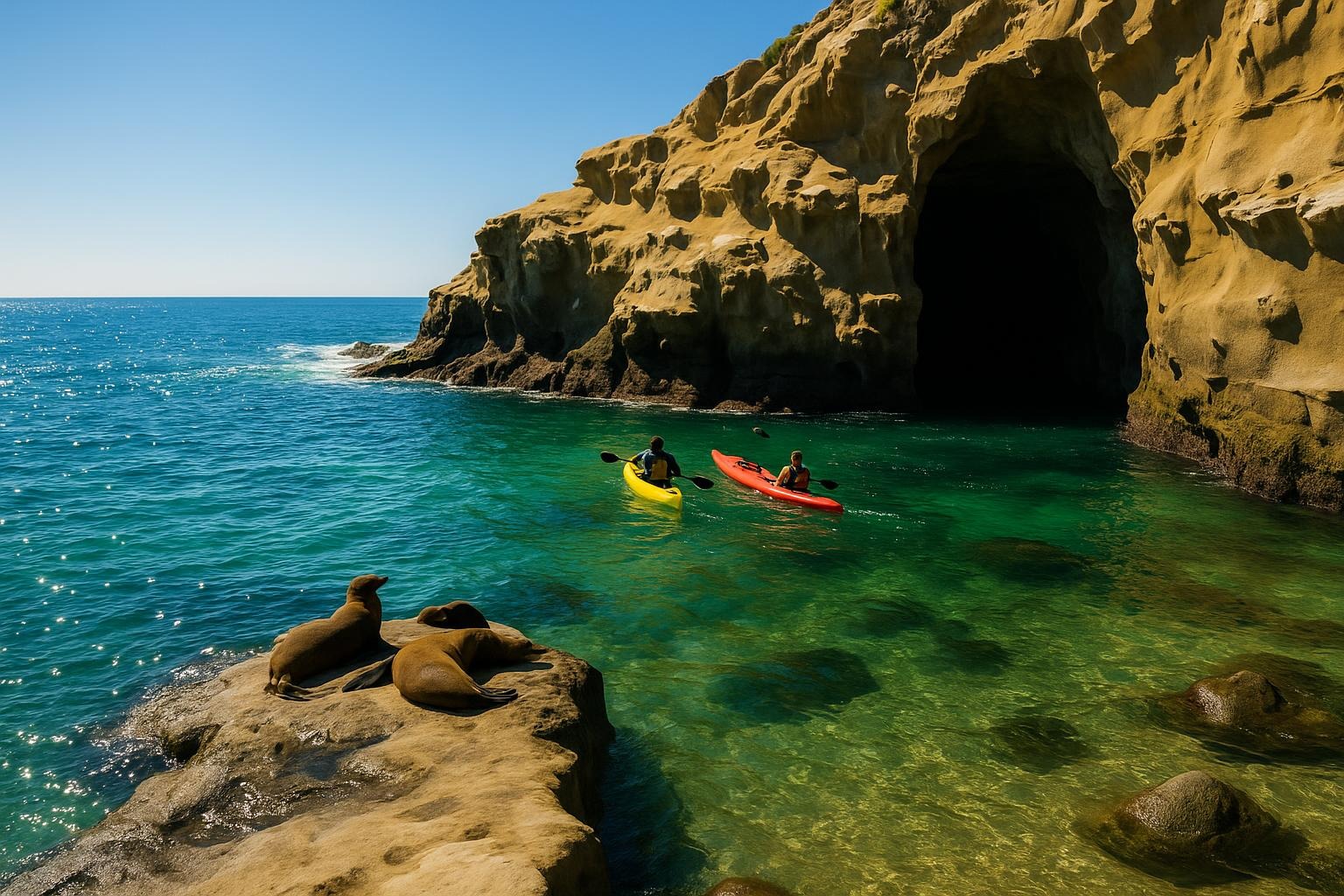
Paddling into the La Jolla sea caves — green water, barking sea lions, and the swell deciding how far you go.
Start in La Jolla, the village on the cliffs at the north end of the city where the sea lions have colonized the Cove and the water is clear enough to snorkel. Kayak out to the seven sea caves from La Jolla Shores in the morning, when the swell is smallest — leopard sharks glide through the shallows from summer into early fall, harmless and everywhere — then walk the Coast Walk trail above the caves and down to the Cove for the sea lions and the seals at Children's Pool. Fish tacos at Oscar's, the boutiques and Warwick's bookshop on Prospect and Girard, and a decision: the Torrey Pines hike above Black's Beach, or an early exit to Point Loma.
Point Loma is the peninsula that closes the bay, and Cabrillo National Monument at its tip is the single best view in San Diego — the whole harbor, downtown, Coronado and the Navy fleet laid out from four hundred feet, with the 1855 Old Point Loma Lighthouse behind you and tide pools at the base of the cliffs at low tide. Time it for the last hour before the park closes, then drive five minutes around to Sunset Cliffs for the sunset itself, which the whole neighborhood turns out to watch from the bluffs. Dinner is in Liberty Station, a converted naval training center on the bay just below, or back in Little Italy. A last round in North Park's breweries, or the Padres under the lights.
Insider Notes
- Book the kayak tour rather than renting. The guided two-hour cave tours (La Jolla Kayak, Everyday California) know which caves the swell allows on the day and go in with you; rentals stay outside. Morning departures are calmest.
- The sea lions at the Cove and the seals at Children's Pool are wild and protected. Stay on the walkways; the fines are real and the smell is worse than the photographs suggest.
- Torrey Pines State Reserve charges per car and the lot fills by ten on weekends. The Guy Fleming and Razor Point trails are the short, dramatic ones — an hour, and the view down onto Black's Beach is the reward.
- Cabrillo National Monument closes at five, and the tide pools on the ocean side are only worth it at a low tide of one foot or less — best on winter afternoons. The entry fee is per vehicle and valid for a week, in case you return.
- Sunset Cliffs has no railings. Stay back from the edge; the sandstone crumbles, and every year someone learns this the hard way.
- Drop the car at the airport tomorrow morning, not tonight. SAN is ten minutes from downtown and the rental return is inside the airport loop; there is no reason to give the car up early.
Where to Eat
- Lunch — Oscar's Mexican Seafood on Pearl Street in La Jolla: smoked fish tacos and ceviche at a walk-up counter, the best cheap lunch in the city. Or George's Ocean Terrace on Prospect for the same food idea with a cliff-top view and a tablecloth.
- Dinner — Callie in East Village, Travis Swikard's Michelin-starred Mediterranean, the best restaurant in San Diego — or Juniper & Ivy in Little Italy, the room that started the city's food revival. Book both a couple of weeks ahead.
- Alternative — Liberty Public Market in Liberty Station, a food hall in the old naval commissary, for the group that wants five cuisines and a beer garden ten minutes from Sunset Cliffs.
- Sundowner — Sunset Cliffs, on the bluff at the end of Ladera Street, with a bottle from Pure Project or North Park Beer Co. This is the last sunset of the trip; the neighborhood applauds when it goes down, and you will too.
Tickets & Costs
| La Jolla sea cave kayak tour, 2 hours, per person | $65–95 |
| Snorkel gear rental, per person | $25–30 |
| Torrey Pines State Reserve, per vehicle | $15–25 |
| Cabrillo National Monument, per vehicle (valid 7 days) | $20 |
| Sunset Cliffs Natural Park | Free |
More San Diego?
Add a third night and follow the three-night San Diego itinerary: a day for the Zoo and Balboa Park, a day for La Jolla's sea caves and food, and a day for Coronado, Point Loma and Cabrillo National Monument.
Day 11 · Departure
Home from San Diego
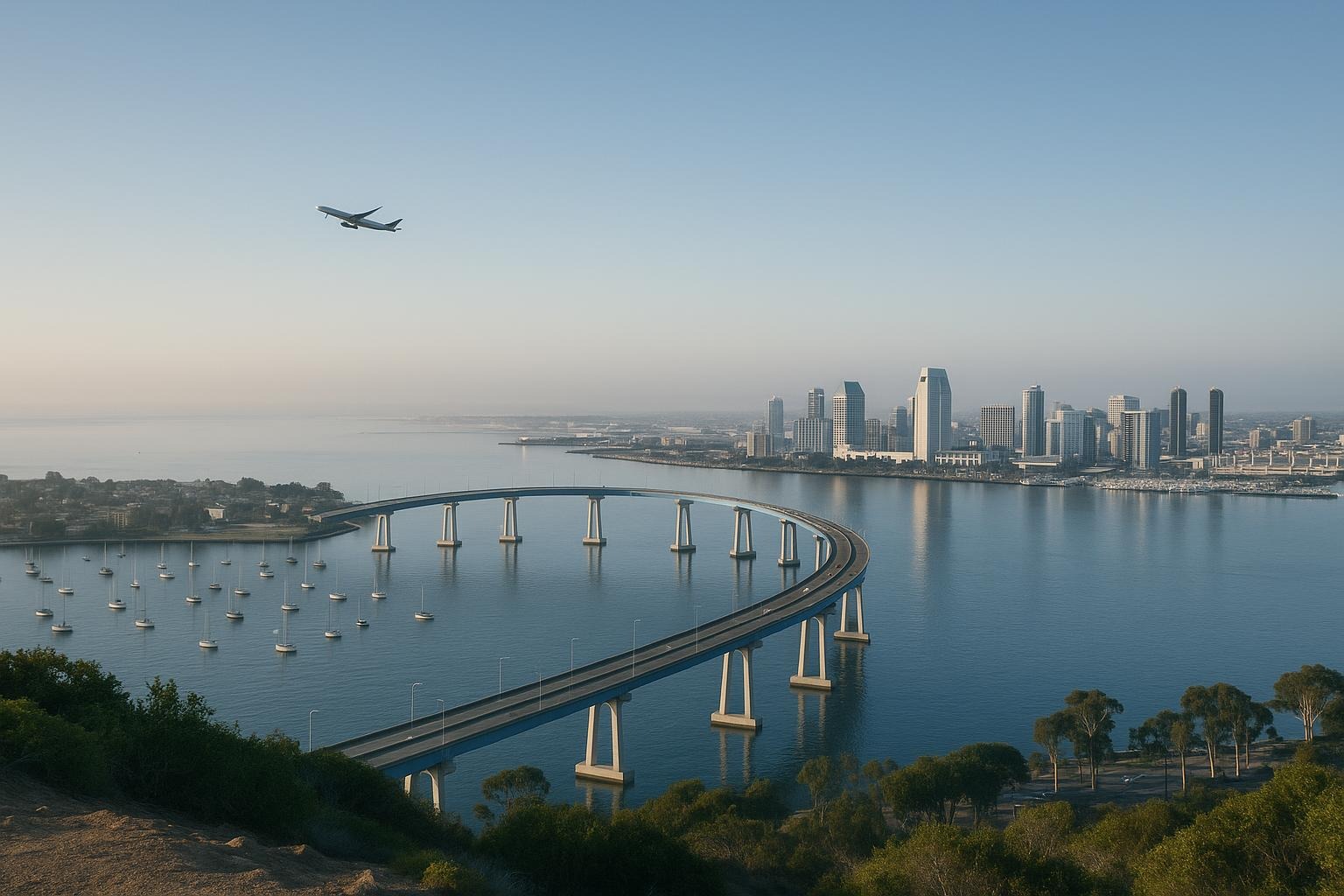
Wheels up over the bay — eleven days of coastline folding away beneath the wing.
San Diego's airport is the one great logistical gift of this route: it sits on the bay at the edge of downtown, ten minutes from any hotel in the city, with the rental return inside the airport loop. There is no reason for a dawn transfer. Have a last breakfast — a Cardiff Crack sandwich at Morning Glory in Little Italy, or the pancakes at Hash House A Go Go — drop the car, and be at the gate an hour before the flight. If the departure is in the evening, Balboa Park's museums and the Zoo are fifteen minutes from the airport and worth every hour you have.
Insider Notes
- Return the car with a full tank. The gas station at the entrance to the rental return loop on Pacific Highway is the last one; the rental companies charge nearly double for fuel.
- SAN's Terminal 2 has the better lounges and food; check which terminal your airline uses before you drop the car, because the two terminals are connected only by shuttle.
- Late flight? The airport will hold bags at the Airport Ambassador desk for a fee, and the Zoo is fifteen minutes away.
Where to Eat
- Breakfast — Morning Glory in Little Italy for the Cardiff Crack sandwich and a room that looks like a 1970s fever dream, or Hash House A Go Go for pancakes the size of the plate.
Tickets & Costs
| Rental car return, SAN | Included |
| Rideshare, downtown to SAN, if the car is returned early | $15–20 |
Extending the Trip
Four more nights in Los Angeles.
Add four nights after Day 8 and the trip becomes a proper fortnight — fourteen nights, San Francisco to San Diego, with Los Angeles done properly in the middle rather than glimpsed from the coast road. Your Santa Monica night becomes Day 1 of the five-night Los Angeles itinerary, and you rejoin this route at Day 9 with the drive to Laguna and Coronado.
The five Los Angeles days
| Day | The day |
|---|---|
| LA 1 | Venice Beach and Santa Monica — the beach path, the canals, Abbot Kinney (this itinerary's Day 8) |
| LA 2 | Beverly Hills — Rodeo Drive, Greystone Mansion, the Polo Lounge, the Getty Center at sunset |
| LA 3 | Universal Studios Hollywood, then Griffith Observatory for the city lights |
| LA 4 | Malibu — the Getty Villa, Point Dume, El Matador, Nobu on the deck |
| LA 5 | Santa Catalina Island — the boat from Long Beach, Avalon, the sea caves and the Casino |
Base yourself in Santa Monica for all five nights (simplest, and the beach every morning), or split — Santa Monica for the first and last, West Hollywood or Beverly Hills for the middle three. Keep the car. Hotel picks at both tiers, day-by-day detail and every ticket price are on the five-night Los Angeles page.
The Classic
≈ $2,600
Four extra nights for two, hotel, food and tickets.
The Elevated
≈ $5,500
The same four nights at the top tier, with a private guide for a day.
Before You Go
Book these before you leave home.
Six things on this itinerary sell out days to weeks ahead in season, and there is no walk-up alternative for any of them. Admissions and excursions total roughly $550–700 per person, plus the car.
The six that sell out
- Alcatraz — sixty to ninety days ahead, direct from Alcatraz City Cruises, for Day 3
- Scribe Winery — the tasting at the hacienda books out weeks ahead
- Chez Noir in Carmel — the day the reservation calendar opens
- Hearst Castle — a timed tour, if you are taking it on Day 7
- The Tavern at Mattei's or Bell's in Los Alamos — two to three weeks ahead
- The La Jolla kayak tour — a week ahead in summer
- Plus the tables: Gjelina or Felix in Venice, Che Fico in San Francisco, and Callie in San Diego, all booked the day their calendars open. And the one-way rental car, reserved early — one-way inventory is limited and the drop fee rises as the date approaches.
Every ticket, gathered · per person unless noted
| San Francisco · Days 1–3 | |
| Rideshare, SFO to downtown | $45–70 |
| Alcatraz Day Tour / Night Tour | $45 / $56 |
| Bike rental, full day | $40–55 |
| Golden Gate Ferry, Sausalito to the Ferry Building | $14–15 |
| Cable car, single ride | $8 |
| de Young Museum / Japanese Tea Garden | $20 / $15 |
| Sonoma and the coast · Days 4–5 | |
| One-way rental car, 7 days, including drop fee (per car) | $900–1,300 |
| Golden Gate Bridge toll, southbound (per car) | $10 |
| Scribe / Gundlach Bundschu / Three Sticks tastings | $50–95 |
| Sonoma Valley Bike Tours, half day | $150–180 |
| Elkhorn Slough kayak rental, 2 hours | $45–60 |
| The Monterey Peninsula and Big Sur · Days 6–7 | |
| Point Lobos (per vehicle) | $10 |
| 17-Mile Drive (per vehicle, refundable) | $12.25 |
| Carmel Mission | $13 |
| Pfeiffer Beach / Julia Pfeiffer Burns (per vehicle) | $15 / $10 |
| Hearst Castle, Grand Rooms tour | $30 |
| Tin City or Los Olivos tastings | $25–40 |
| Los Angeles and San Diego · Days 8–11 | |
| Bike rental, Santa Monica, half day | $30–50 |
| El Matador / Crystal Cove parking (per vehicle) | $8–10 / $15 |
| La Jolla sea cave kayak tour | $65–95 |
| Torrey Pines (per vehicle) | $15–25 |
| Cabrillo National Monument (per vehicle, 7 days) | $20 |
| Padres game, if added | $30–120 |
| Approximate total, admissions and excursions | $550–700 |
Before you go — passports, ESTA, and driving licences
- Visitors from Canada need no visa for the United States but must carry a passport valid for the length of the stay. Visitors from the UK, the EU and other Visa Waiver countries need an approved ESTA before boarding, applied for online at least seventy-two hours ahead. Indian passport holders need a B-2 visitor visa, and appointment waits at the consulates vary from weeks to many months, so start early.
- Your driving licence from home is valid for renting and driving in California for the length of a tourist visit. An International Driving Permit is not required but is worth carrying if your licence is not in English.
Money and tipping
- Tipping is not optional. Eighteen to twenty percent of the pre-tax bill in restaurants, twenty for good service; a dollar or two per drink at the bar; $5 to $10 a day for housekeeping; $5 for a valet. Tasting-room staff appreciate a tip on a good pour but do not expect one.
- Sales tax is added at the register, not shown on the shelf — between 7.25 and 10.75 percent depending on the county. Menu prices are pre-tax and pre-tip; a $100 dinner is $130 out the door.
- Hotel taxes and fees are the real sting. San Francisco adds over 16 percent, Los Angeles 14 to 17, San Diego 12.5 plus a tourism assessment — and many beach and resort hotels add a "resort fee" or "destination fee" of $30 to $60 a night on top. Every rate in this itinerary is quoted before these; budget for them.
- Cards are accepted everywhere on this route, including at farmers markets and food trucks. Decline dynamic currency conversion if a card terminal offers to charge you in your home currency; the rate is always worse.
Driving in California — what costs people money
- Highway 1 closes. Big Sur's ninety miles are cut into an active landslide zone, and the road has been closed somewhere along its length for more years than not. It fully reopened in January 2026 after nearly three years; it closed again for wildfires that August. Search "Caltrans QuickMap" the night before Day 7, and if the road is shut, use the 101 plan written into that day.
- The Golden Gate Bridge toll is electronic and southbound only. No booths. Rental companies pass it on with a daily administrative fee; pay it yourself at goldengate.org within 48 hours, using the licence plate, and the fee disappears.
- Car break-ins are the practical crime risk in San Francisco and at coastal trailheads. Never leave anything visible in a parked car — not a jacket, not a charging cable. This is why the car is collected on the way out of the city.
- One-way rentals carry a drop fee of $100 to $300 between San Francisco and San Diego, and inventory is limited in September. Book early, choose a mid-size automatic unless you want the convertible, and confirm that unlimited mileage is included; it usually is.
- Fuel is the most expensive in the mainland US, and most expensive of all in Big Sur and Malibu. Fill up in Carmel, Santa Barbara and Santa Monica.
- Fog changes the road. The marine layer can drop visibility to a few car lengths on Highway 1 in the morning and evening. Headlights on, and slow down.
September and October — the seasonal reality
- These are the finest weeks of the year on this coast — the fog retreats, the water is at its warmest, the hills are gold — and they are also fire season. Most years nothing happens; some years the air fills with smoke and a park or a road closes for a week. Travel insurance that covers cancellation for wildfire is worth the premium, and this itinerary's Big Sur day has a written alternative for a reason.
- Summer, by contrast, is fog: "June gloom" sits over the coast from Santa Cruz to Santa Monica most mornings and often all day, and the Monterey Peninsula can go a week without seeing the sun in July. It burns off inland — Sonoma and the Santa Ynez Valley will be hot — but the beach days can disappoint. Spring, from mid-April to May, is the second-best window: green hills, wildflowers, whales, and prices well below September.
- Restaurants on this coast open at five for dinner and are often closed on Mondays and Tuesdays in the smaller towns — Carmel, Big Sur, Los Olivos. Sunday brunch is a competitive sport everywhere. Book.
Couple or crew?
- Couples should lean into Olea, L'Auberge Carmel, Mattei's Tavern and the Lodge at Torrey Pines — the four hotels on this route that are built for two.
- Groups get the most out of The Clancy, Carmel Valley Ranch, Alisal Ranch, the Marina del Rey Hotel and The Lafayette. Ask about connecting rooms and two-bedroom suites, and a mid-size SUV rather than the convertible — four people's luggage and a case of wine need the trunk.
- Either way, the days are identical. Only the beds and the dinner budgets change.
Practical odds and ends
- Layers decide how much you enjoy this trip. A San Francisco evening is 55°F in August; a Santa Ynez afternoon is 95. Pack for both, every day, and keep a jacket in the car.
- The sun is stronger than it feels. The marine layer diffuses it and people burn through fog. Sunscreen and a hat on the bike days, in Big Sur and on the water in La Jolla.
- Tap water is excellent everywhere on this route. Carry a bottle; California's parks and trailheads have refill stations, and a bottle of water at a beach concession is $4.
- Sea lions, seals and otters are protected by federal law. Stay fifty feet back on land and in the water — the fines are real, and the sea lions bite.
- Poison oak lines every trail from Sonoma to San Diego. Three leaves, waxy, red in autumn. Long trousers on the Lands End, Point Lobos and Torrey Pines trails if you are prone to it.
- Get an eSIM before you leave if you are arriving from abroad; it activates on landing, and you will want data for the reservations, the tide tables and the road status. Expect none in Big Sur.
- Reservations run on apps. Resy, OpenTable and Tock hold most of the tables in this itinerary; set alerts for the hard ones. Walk-in culture survives only at the taco counters and the oyster bars.
- The emergency number is 911 throughout the United States. Travel medical coverage is essential — a night in an American hospital without it runs into five figures.
- Pack light and soft. You will carry bags up Carmel's stairs and across Santa Monica's sand, and the rental's trunk has to hold a case of Sonoma wine on the way home. One medium case each, and a folding duffel.